
Car Rental Deposit Return Control: A Practical Guide
The car owner returns the deposit — but the control stays in your hands: a signed act, payment proof and a written settlement.
7 min read

In this article
The car owner returns the deposit, under the terms stated in the listing and the contract — and JanCar neither receives nor holds it. Once the owner has sent the money, bank processing is a separate stage that neither party can influence. To stay in control at every step, keep the return act, the payment proof and a written final settlement.
Key Takeaways
- Who returns it — the car owner (host), not the platform.
- Two clocks — the release deadline is agreed with you; bank processing is not.
- Three documents — the handover/return act, payment proof, and a written final settlement.
- Clarify upfront — the amount, the return deadline and the deduction cases.
- If the deposit doesn't arrive — a written reminder first, then legal routes.
Who Returns the Deposit: The Owner, the Bank and JanCar's Role
The obligation to return the deposit sits with the car owner, because they're the one who received it from you directly. JanCar is a peer-to-peer platform: it connects renter and owner, but it never receives, blocks or holds the deposit money. So any question about the deposit goes straight to the owner.
The deposit amount, its terms, insurance and the handover procedure are set by the listing, the owner and the rental agreement. Check them on the listing itself and confirm verbally with the owner before paying anything.
The Two-Clock Model: Release and Bank Processing
The first clock is the owner's release: they inspect the car, calculate the final amount and send the deposit. That deadline is an agreement between you and the owner — worth writing into the contract or at least fixing in a message.
The second clock is bank processing: once the money has been sent, the transfer can technically take time depending on the bank, the card or the transfer method. There are no exact universal timelines, and we won't invent any — for current figures, ask your bank or check with the Central Bank of Armenia (cba.am).
The practical takeaway is simple: "the owner sent it" and "the money arrived" are two different moments. Ask for proof of sending, and the gap between those two moments will stop worrying you.
What to Clarify Upfront, Before Handing Over the Car
A smooth deposit return starts not on return day but at the moment of agreement. Before you hand over any money, clarify three things and write them down.
- The deposit amount and method — cash or transfer, and to whose card or account.
- The return deadline — how many hours or days after the car is accepted back.
- Deduction cases — fuel, mileage overrun, new damage, late return.
If the owner refuses to name a deadline, that's a signal: choosing a different listing is safer. A verbal "I'll give it later" promise gives you nothing to hold anyone to.
Step-by-Step Checklist: Controlling the Deposit Return
This checklist is built so that every step leaves a piece of evidence in your hands. The order:
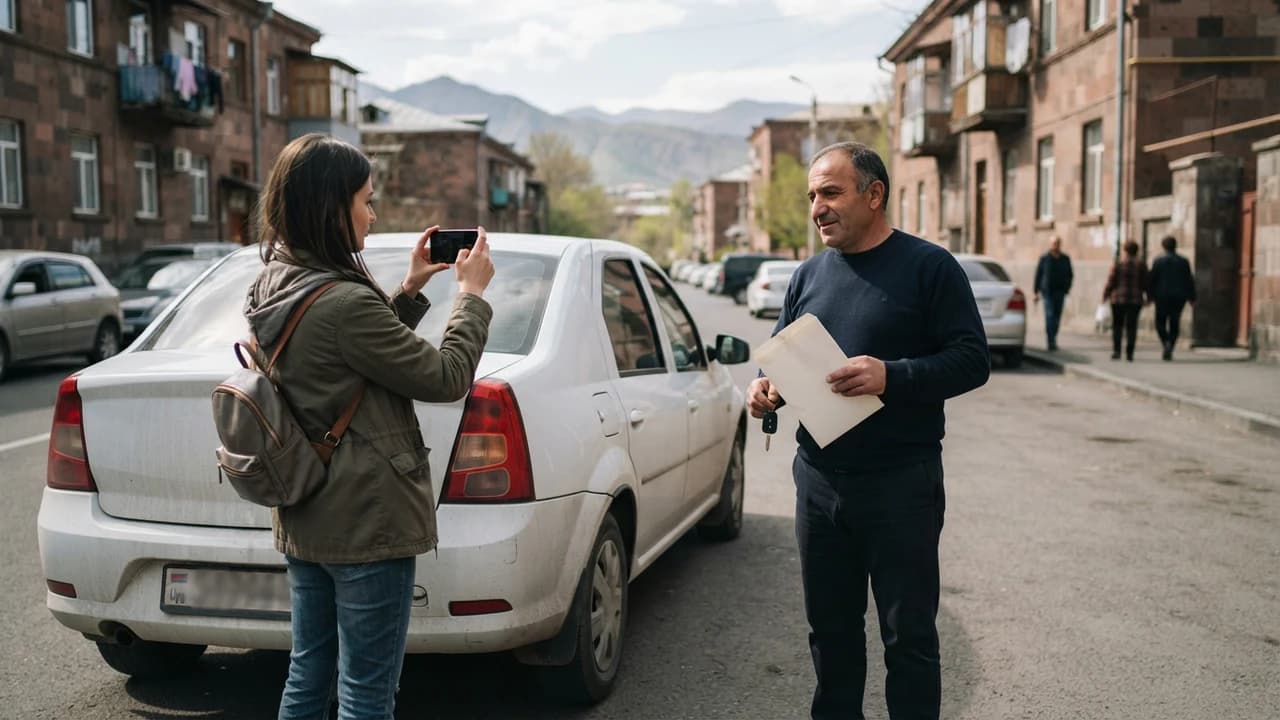
- At pickup — walk around the car together, photograph existing damage, the fuel level and the odometer.
- Fill out the handover/acceptance act — digital or paper, with both signatures and a date.
- At return — repeat the same routine: photos from the same angles, fuel, mileage.
- Get a written final settlement — deposit amount, deductions and the balance to be returned.
- Agree on the sending method and ask for proof of sending.
- Confirm receipt on your card or account statement and keep it.
Documents at the Moment of Return
Your key document at return time is the acceptance act. It should record the date, the time, the mileage, the fuel level and whether any new damage was recorded (or list it if there was). Photos are an annex to the act — keep them in the same folder.
The Written Final Settlement
A written final settlement is a one-line document: "deposit X drams, Y deducted for reason Z, returning W." Even a message the owner replies to with agreement counts. Don't send money without this settlement — in any later dispute, it's your main anchor.
The Evidence File: What to Keep and for How Long
An evidence file is a single folder on your phone or email where all the rental documents live together. Keep it at least until the deposit has fully arrived — better still, for a few months after.
- The handover/acceptance act, with both signatures.
- Pickup and return photos — damage, fuel, mileage.
- Proof of the deposit payment — a transfer receipt or card statement.
- The written final settlement.
- Correspondence with the owner, with dates.
As JanCar's editor, I call this file the "peace-of-mind folder": once it's complete, getting your deposit back stops being an open-ended wait and becomes a verifiable process.
Mistakes and Main Risks
The most common mistake is relying on a verbal agreement: the deposit amount, the deadline and the deduction terms exist only in memory. The second mistake is not demanding a final settlement — without one, any deduction becomes contestable.
The third risk is a banking delay: renters sometimes blame the owner for what is really technical processing of the transfer. Always check the proof of sending before drawing conclusions.
If the Deposit Isn't Returned: Next Steps
If the agreed deadline has passed, the first step is a written reminder: reference the act, the settlement and the deadline in a dated message. In most cases that's enough, since delays are often technical.
If there's no response, your evidence file is the basis for a legal route: provisions of the Civil Code of Armenia on the performance of obligations apply to rental relationships, and through them you can consult a lawyer or file a claim in court. Check the current version of the Code on arlis.am before citing it. JanCar does not mediate over deposit money, because it never held it.
Frequently Asked Questions
How long does a deposit return take via bank?
It depends on the bank, the card and the transfer method — there's no single number. For exact figures, contact your bank or the Central Bank of Armenia. Ask the owner for proof of sending: it separates their release from the bank's processing.
What if the owner doesn't return the deposit?
Start with a written reminder referencing the act and the final settlement. The next step is legal advice — your document file makes the claim well-founded. Avoid self-help measures; they only complicate matters.
Does JanCar hold the deposit?
No. JanCar does not receive, block or hold deposits. If a listing requires one, the money and its return are arranged directly between renter and owner.
Related Reading Paths
Continue the topic with these vetted related guides.
- Evidence for Car Rental Disputes: A Guide for Owners
- Vehicle Details in a Rental Listing: Verification Guide
This is general information. JanCar does not receive or hold a vehicle deposit. Check price, deposit, insurance and every other term on the listing and directly with the owner.
More JanCar guides
Continue with these closely related practical guides.
Frequently asked questions
How long does a deposit return take via bank?
It depends on the bank, the card and the transfer method — there's no single number. For exact figures, contact your bank or the Central Bank of Armenia. Ask the owner for proof of sending: it separates their release from the bank's processing.
What if the owner doesn't return the deposit?
Start with a written reminder referencing the act and the final settlement. The next step is legal advice — your document file makes the claim well-founded. Avoid self-help measures; they only complicate matters.
Does JanCar hold the deposit?
No. JanCar does not receive, block or hold deposits. If a listing requires one, the money and its return are arranged directly between renter and owner.
Where to go next
Sources
- JanCar — how it works
jancar.am · official source
- JanCar car catalogue
jancar.am · official source