
Traffic fine after rental: owner's guide
When a fine arrives after a rental, the owner should first verify the notice on an official source, match it against the rental period and contract, then decide who is responsible for payment.
9 min read
In this article
When a traffic fine arrives after a rental, the owner should first verify the notice on an official source, match it against the rental period and contract, then decide who is responsible for payment.
Key takeaways
The driver — meaning the renter — bears responsibility for the fine, unless the contract says otherwise. The owner must be able to prove the rental period.
Here are the main steps, which we'll break down in detail below.
- Verify the notice on an official source — roadpolice.am or e-gov.am — before taking any action.
- Match the fine's date against the rental contract and the handover-acceptance act.
- Keep all evidence — contract, act, correspondence, photos.
- Don't pay unagreed amounts before checking with the renter.
- JanCar is a connecting platform and holds no deposit or fine liability.
What is a traffic fine and how does it reach the owner
A traffic fine is an administrative penalty for breaking road rules, and the notice is sent to the registered owner of the vehicle.
The state ties the fine to the license plate, not to the driver's identity. That's why an owner can receive a notice for a violation committed by the renter.
Official channels: roadpolice.am and e-gov.am
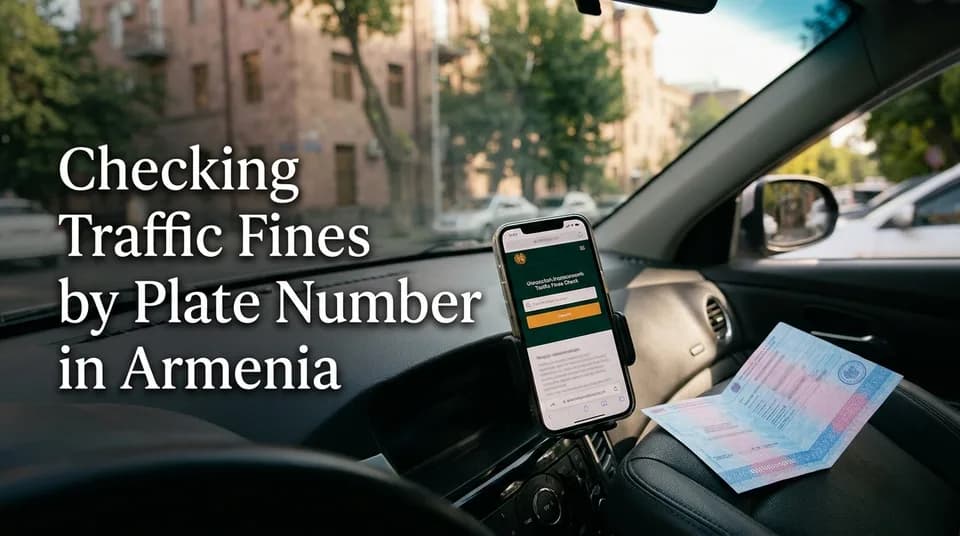
The fine notice may arrive by mail, but the more reliable way is to check it in electronic systems. The RA Police official website (roadpolice.am) and the RA Government e-services portal (e-gov.am) let you check fines by plate number or personal data.
Data in these systems updates regularly, so note the date of your check in your records.
What data a legitimate notice should contain
A trustworthy notice includes the violation date, time, location, the vehicle's plate number, and the type of violation. If any of these is missing or looks suspicious, verify it on the official source.
Beware of fake notices that may carry a payment link to a suspicious website. Official payment routes exist only within state systems.
Step 1. Verify the notice on an official source
The first step after receiving a fine is to confirm the notice's authenticity on an official source — before starting any discussion with the renter.
How to check
Log in to e-gov.am or roadpolice.am and enter the vehicle's plate number or your personal data. The system will show all registered fines, including unpaid ones.
We recommend running this check after every rental, at least once, so fines don't pile up.
Protection against fake notices
If the notice contains a payment link leading to a non-official site, don't follow it. Official payment happens only through e-gov.am or banking systems tied to state registration.
When in doubt, call the RA Police information service or visit the nearest department to confirm the notice's authenticity.
Step 2. Match the rental period and the contract
To determine who's responsible for the fine, you need to establish whether the violation occurred during the rental period.
Take out the rental contract and the handover-acceptance act, which state the rental start and end dates. Compare this period with the date on the fine notice.
Key contract clauses
A well-drafted contract includes the renter's personal data, the rental period, mileage, fuel level, and both parties' signatures. This document is your primary evidence.
If the contract has a separate clause about fines, read it carefully. Some owners stipulate that the renter pays the fine, others that the owner does.
Example of matching the period
Say the rental ran from June 1 to June 5. The fine notice shows a violation on June 3. In this case, the violation falls within the rental period, and the renter bears responsibility.
If the violation occurred on June 7 — after the rental ended — the owner is responsible. Here it's crucial to have an accurate handover-acceptance act confirming the actual return time.
Step 3. Keep the evidence
Preserving evidence is your main defense in disputes — both with the renter and with state bodies.
Rental contract
Keep the contract for at least six months after the rental ends. Within this period, fine notices usually reach the owner.
Handover-acceptance act
In the act, record the actual return date and time, as well as the vehicle's condition. Both parties' signatures give this document legal force.
Correspondence with the renter
Keep all messages — text exchanges, emails, and app chats where the fine is discussed. This correspondence can prove useful in a court dispute.
Step 4. Contact the renter and agree on payment
Once you've confirmed the violation occurred during the rental period, reach out to the renter and inform them about the fine, attaching a copy of the notice.
State clearly how much needs to be paid and by what date. Agree on the payment method — transfer, cash, or another option.
Avoiding unagreed charges
Never charge the renter an amount that wasn't agreed in advance in the contract or a separate agreement. This can lead to disputes and loss of trust.
The best approach is transparency — show the fine notice, explain your position, and give the renter a chance to contest it.
If the renter refuses to pay
If the renter refuses to pay, you have two options: pay the fine yourself and then claim the amount from the renter through court, or approach law enforcement to start an administrative process.
To support a court claim, you'll need all the evidence — the contract, the act, and the correspondence. You can also consult a lawyer for advice.
JanCar's role in the fine matter
JanCar is a connecting platform that brings owners and renters together, but it holds no deposit or fine liability.
The vehicle, price, deposit, insurance, and handover are confirmed by the listing, with the owner, and by the contract. This means JanCar doesn't mediate in fine matters and doesn't guarantee payment.
JanCar is a connecting platform
The platform provides tools for publishing listings, vetting renters, and communicating. It doesn't take on the vehicle owner's responsibilities.
The owner is responsible for their car, and the renter for their driving. This division should be clearly reflected in the contract.
Deposit and insurance terms
JanCar does not receive, block, or hold a deposit. If a listing states a deposit, it's transferred directly to the owner under terms agreed with the renter.
Insurance also needs to be checked on the listing and with the owner. The platform doesn't guarantee insurance coverage. We recommend seeing the insurance policy before the rental and understanding what cases it covers.
How to contest and pay a fine
To contest a fine, you need to apply to the RA Police within the administrative process, and payment is made through official systems.
The right to contest a fine is established by RA legislation, and the application must be submitted within set deadlines. For exact deadlines, consult the RA legal information system (arlis.am) or the police.
Payment methods
You can pay the fine through the e-gov.am portal, by bank transfer, or through other official channels. After paying, keep the receipt as proof.
Contest deadlines
Contest deadlines are set by RA legislation and may change. As of publication (2025), check arlis.am or contact the police for the current deadlines.
Common mistakes and risks
Owners often repeat a few mistakes that can cost them dearly. Here's how to avoid them.
Unverified notice
Many pay the fine without checking it on an official source. This can lead to paying a fake notice or being charged with incorrect data. Always check before paying.
Late payment
Paying a fine late can lead to additional penalties. Pay on time, following the deadlines stated in official systems.
Missing evidence
Without a contract and handover-acceptance act, you can't prove the rental period. This is your main risk in a dispute.
Frequently asked questions
Who pays the fine — the renter or the owner?
The driver — the renter — bears responsibility for the fine, unless the contract says otherwise. The owner must prove the rental period through the contract and the handover-acceptance act.
How do I check a fine through an official channel?
Log in to roadpolice.am or e-gov.am and enter the vehicle's plate number or your personal data. The system will show all registered fines.
What if the renter refuses to pay?
You can pay the fine yourself and then claim the amount from the renter through court, using the contract and evidence. Consult a lawyer for advice.
Does JanCar bear responsibility for fines?
No. JanCar is a connecting platform and holds no deposit or fine liability. The vehicle, price, deposit, and insurance are confirmed by the listing and with the owner.
How long should I keep rental documents?
We recommend keeping them for at least six months after the rental ends, so you can respond to fine notices.
Official sources
The facts in this article were verified against these sources, as confirmed in the brief.
Related reading
Continue the topic with these verified related guides.
- Proving the car return place and time: a practical guide
- How an owner vets a rental request: 5 steps
- Checking the final rental settlement: 7 points
- Parking fine or tow in Yerevan: what to do
This is general information. JanCar does not receive or hold a vehicle deposit. Check price, deposit, insurance and every other term on the listing and directly with the owner.
More JanCar guides
Continue with these closely related practical guides.
- Deposit policy for car owners: a guide
- Second driver policy for owners: a guide
- Airport Car Handover: Owner's Guide (ZVARTNOTS)
- Car Rental Payment Currency and Conversion: A Guide
- Extending car rental insurance: owner's checklist
- Post-Return Car Inspection: Owner's Checklist
- Car Rental Cost Ledger: A Practical Owner's Guide
Frequently asked questions
Who pays the fine — the renter or the owner?
The driver — the renter — bears responsibility for the fine, unless the contract says otherwise. The owner must prove the rental period through the contract and the handover-acceptance act.
How do I check a fine through an official channel?
Log in to roadpolice.am or e-gov.am and enter the vehicle's plate number or your personal data. The system will show all registered fines.
What if the renter refuses to pay?
You can pay the fine yourself and then claim the amount from the renter through court, using the contract and evidence. Consult a lawyer for advice.
Does JanCar bear responsibility for fines?
No. JanCar is a connecting platform and holds no deposit or fine liability. The vehicle, price, deposit, and insurance are confirmed by the listing and with the owner.
How long should I keep rental documents?
We recommend keeping them for at least six months after the rental ends, so you can respond to fine notices.
Where to go next
- "Show number": Why an Owner's Phone Number Appears on JanCar Only After You Sign In