
Checking Tire Pressure in a Rental Car
The right tire pressure for a rental car isn't a "standard number" — it's written on the car itself. Here's where to find the sticker and what to check at pickup.
8 min read
In this article
The right tire pressure for a rental car isn't a "standard number" — it's written on the car itself. Here's where to find the sticker and what to check at pickup.
Determine the right pressure for your rental car not by a "standard number" but by the pressure sticker on the vehicle itself, usually stuck to the driver's door jamb. At pickup, check the sticker, the visible condition of the tires, and the load limit with the owner. These three steps take a few minutes but protect both your safety and your wallet.
Why check the pressure right at pickup
The pickup inspection is a renter's main protection, because after that point any problem can be attributed to you. If a tire was already half-flat at handover and you didn't record it, you'll struggle to justify an issue that appears on the road.
The second reason is safety. An underinflated tire worsens handling, increases fuel consumption and heats up on long routes. In Armenia, mountain destinations — Dilijan, Sevan, Tatev — mean long climbs where tire condition really shows.
Third is the paperwork side: if you photograph the tires on pickup day and note their condition in the handover act, both sides will have an unambiguous basis at return.
Where to find the correct pressure: the car's sticker, not a "standard number"
The manufacturer sets the correct pressure, and it's written on the sticker attached to the car. Open the driver's door and look at the door jamb or the side face of the door. On some cars the sticker sits under the trunk lid or inside the fuel filler flap.
The sticker lists pressures for front and rear wheels, usually in bar or psi. Those are the right numbers for your specific car — no matter what "average value" the internet quotes.
The two rows on the sticker: unloaded and loaded car
Many stickers give two options: "normal" or unloaded, and "full load" or fully laden. If you're driving alone or with family around town, the unloaded figure is enough.
If you have four passengers, luggage filling the trunk, or a long mountain route ahead, use the loaded row. The difference looks small, but under load is exactly when low pressure becomes most dangerous.
Why not rely on the writing on the tire sidewall
The number on the tire's sidewall is the tire's maximum permissible pressure and load index — not the recommended operating pressure. Even experienced drivers mix this up often.
International standards for tire markings and load indexes are published by UNECE (unece.org, checked 2024). The practical takeaway is simple: take your operating pressure from the car's sticker; the sidewall marking is only a ceiling that must never be exceeded.
Step-by-step checklist at pickup
At pickup the checklist takes 10–15 minutes and is done with the owner or their representative present. Go through these steps:
- Find the sticker on the driver's door jamb and pick the row matching your route — unloaded or loaded.
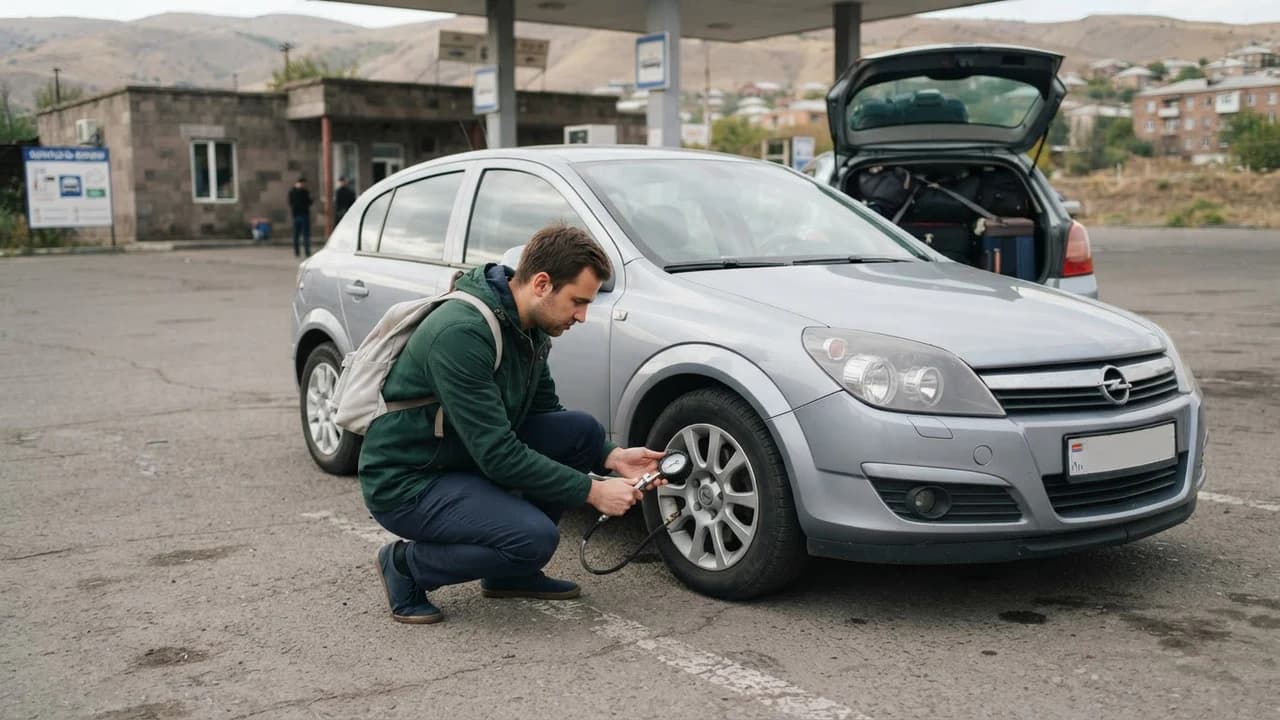
- Measure the pressure with a gauge if possible; many owners provide a compressor with a built-in gauge along with the car.
- Inspect all four tires for visible damage — cuts, bulges, wear.
- Check the spare wheel and tools, if they're part of the car's kit.
- Confirm the load limit with the owner — how many passengers and how much luggage they consider normal.
- Record the condition with photos and notes in the handover act, signed by both parties.
Inspecting for visible damage: cuts, bulges, wear
Run your hand and eye over the tire's sidewall: a cut or bulge ("blowout risk") there is a serious sign and should be discussed before departure. Also check tread wear — if the indicators are nearly flush, tell the owner.
Note every existing defect in the handover act or photograph it with a date. It obligates you to nothing, but protects both sides at return.
Confirming the load limit with the owner
Every tire has a load index — the maximum weight per wheel. For a renter the practical question is simple: "How many passengers and how much luggage do you allow?" The owner knows what their car can handle.
If you're planning a mountain route with a full trunk, mention it in advance. This is also where the owner's advice helps — they can set the pressure to the loaded figures beforehand.
No pressure gauge? Safe alternatives
Without a gauge you can estimate the pressure roughly and judge by behavior, but the final check still needs a gauge. First step: ask the owner when the pressure was last checked and whether a compressor comes with the car.
Workable rough methods without a gauge:
- Visual comparison: all four wheels should sit evenly; a noticeably flat wheel is immediately obvious.
- Hand press: pressing firmly on the tread, the tire shouldn't compress easily — a crude indicator, not a precise measurement.
- Behavioral signs: does the car pull to one side on a straight stretch? Does the steering wheel vibrate? If so, stop and check the wheels.
Most modern cars have a dashboard pressure indicator (TPMS); if a tire symbol lights up, that's an immediate signal to stop and check. The most practical solution remains a simple gauge — it costs a few thousand drams and fits in a handbag.
Mistakes and key risks
The most common mistake is relying on a general number: the "same for every car" approach is wrong, because values differ across models and tires. The second mistake is trusting the tire sidewall marking, as explained above.
Risks of low pressure include worse handling, tire overheating and blowout danger at highway speed, higher fuel consumption and uneven wear. An overloaded tire — beyond its pressure and load limits — is just as dangerous, especially on mountain roads.
There's also a financial risk: if a pressure problem surfaces at return and you recorded nothing on pickup day, the dispute gets hard. Photos and a signed act practically eliminate that risk.
JanCar's role and the owner's terms
JanCar is a connecting platform for peer-to-peer car rental in Armenia: the vehicles belong to independent owners, not to the platform. Price, mileage, fuel, insurance and handover terms are set by the listing and with the owner — not by JanCar.
The same applies to the deposit: JanCar does not receive, hold or safeguard it. If a listing states a deposit, it's arranged directly between renter and owner. So direct any questions about pressure and tire condition straight to the owner, before pickup.
The official source for road safety and technical requirements in Armenia is the Police of Armenia (roadpolice.am, checked 2024) — if technical requirements change, verify there.
Frequently asked questions
How often should I check the pressure during the rental?
A good rule: check before departure, before a long route, and whenever a dashboard warning lights up. For rentals longer than a few days, one mid-term check is enough.
Should I keep the same pressure in winter?
Cold naturally lowers pressure, so checks become more frequent in winter. The baseline stays the same — the car's own sticker — and the winter checklist covers seasonal specifics.
If a tire develops a problem on the road, who's responsible?
Responsibility is defined by your contract and the owner's terms, not by the platform. That's exactly why pickup-day photos and a signed handover act are your best evidence. Steps for breakdowns are covered in a separate guide.
Related search paths
Continue the topic with these verified related guides.
This is general information. JanCar does not receive or hold a vehicle deposit. Check price, deposit, insurance and every other term on the listing and directly with the owner.
More JanCar guides
Continue with these closely related practical guides.
Frequently asked questions
How often should I check the pressure during the rental?
A good rule: check before departure, before a long route, and whenever a dashboard warning lights up. For rentals longer than a few days, one mid-term check is enough.
Should I keep the same pressure in winter?
Cold naturally lowers pressure, so checks become more frequent in winter. The baseline stays the same — the car's own sticker — and the winter checklist covers seasonal specifics.
If a tire develops a problem on the road, who's responsible?
Responsibility is defined by your contract and the owner's terms, not by the platform. That's exactly why pickup-day photos and a signed handover act are your best evidence. Steps for breakdowns are covered in a separate guide.
Where to go next
Sources
- JanCar — how it works
jancar.am · official source
- JanCar car catalogue
jancar.am · official source