
Winter Tires on a Rented Car: Pre-Pickup Checklist
Checking winter tires on a rented car starts with the listing: type, wear, pressure and chains. Here's a step-by-step checklist for Armenia's winter roads.
10 min read
In this article
Checking winter tires on a rented car starts with the listing: type, wear, pressure and chains. Here's a step-by-step checklist for Armenia's winter roads.
The winter tire type, wear level, pressure and chain availability on a rented car are set by the vehicle's owner in the listing. So you should check them on the listing before booking, then again at pickup — against your actual route. This article gives you a concrete checklist: what to look at, what to measure, which questions to send the owner, and what to record in the handover act.
Key Takeaways
- Identify the tire type by its sidewall markings: the 3PMSF snowflake symbol is a reliable indicator of a true winter tire; M+S is a more general marking.
- Check wear by measuring tread depth with a coin or ruler — a worn tire loses its core performance exactly when you need it most.
- Confirm chains exist both on the listing and at pickup, and do a trial fitting somewhere warm before your mountain route.
- Seasonal road requirements change — check them as of publication date via official Armenian police sources at roadpolice.am.
- JanCar is a connecting platform: price, deposit, insurance and tire terms are set by the owner, and JanCar neither receives nor holds any deposit.
Why Winter Tires Matter in Armenia
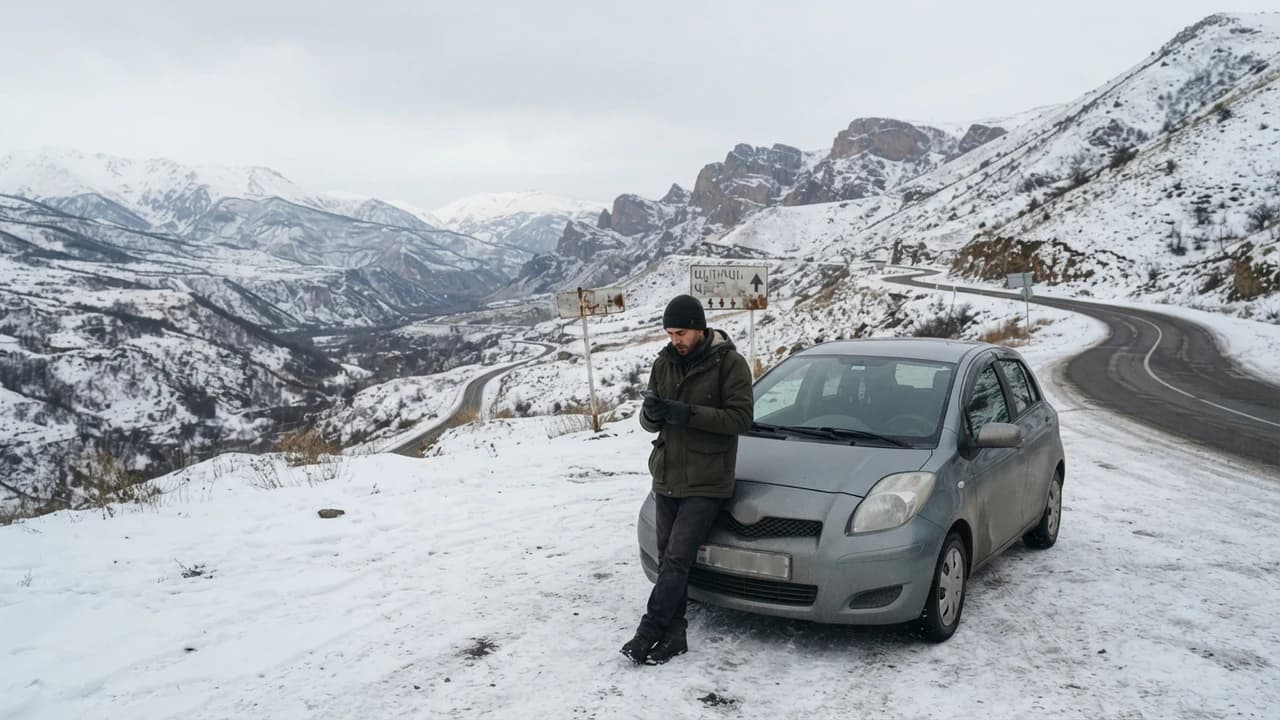
Winter tires matter in Armenia because the country's main tourist routes run through mountain sections where snow and ice are routine from December through March. Tsaghkadzor, Sevan, Jermuk and the high stretches of Tavush and Syunik all demand a tire that still grips the road at low temperatures.
Summer rubber hardens in the cold and loses grip — even on dry asphalt. The result is longer braking distances and sluggish handling. Winter tire compound is designed to stay soft below 0°C, while the sipes clear snow and water out of the contact patch.
When you book a car through JanCar, the owner lists the vehicle's terms, including tire information if they've added it. If that information is missing, the right move is to message the owner before booking — not to assume.
How to Identify the Tire Type: M+S, Winter, Studded
You identify a tire by its sidewall markings: a true winter tire carries the 3PMSF snowflake symbol, M+S is a broader marking, and a studded tire has visible metal studs embedded in the tread. Look at the sidewall where the size and markings are printed.
Marking / Type
What It Means
Winter Use
3PMSF (mountain + snowflake)
The official snowflake symbol awarded to tires that pass a standardized snow test
A reliable indicator of a genuine winter tire
M+S (Mud + Snow)
A general mud-and-snow marking with no mandatory test behind it
Can appear on all-season tires; M+S alone is no guarantee of winter capability
Studded
Metal studs set into the tread blocks
Best traction on ice, but not necessary for every route
Summer
No winter markings present
Not suitable for mountain routes in winter
The 3PMSF Symbol and Why It's a Reliable Indicator
The 3PMSF symbol is reliable because it's only assigned to tires that have passed a standardized snow braking and acceleration test against a reference tire. The symbol shows a three-peak mountain with a snowflake inside.
The practical takeaway is simple: when an owner writes "winter tires," check at pickup whether the sidewall actually shows 3PMSF or just M+S. If it's only M+S, that doesn't mean the tire is bad — but it does mean it never passed a snow test, and now you know the real situation before heading up the mountain.
The Pickup Checklist: Wear, Pressure and Chains
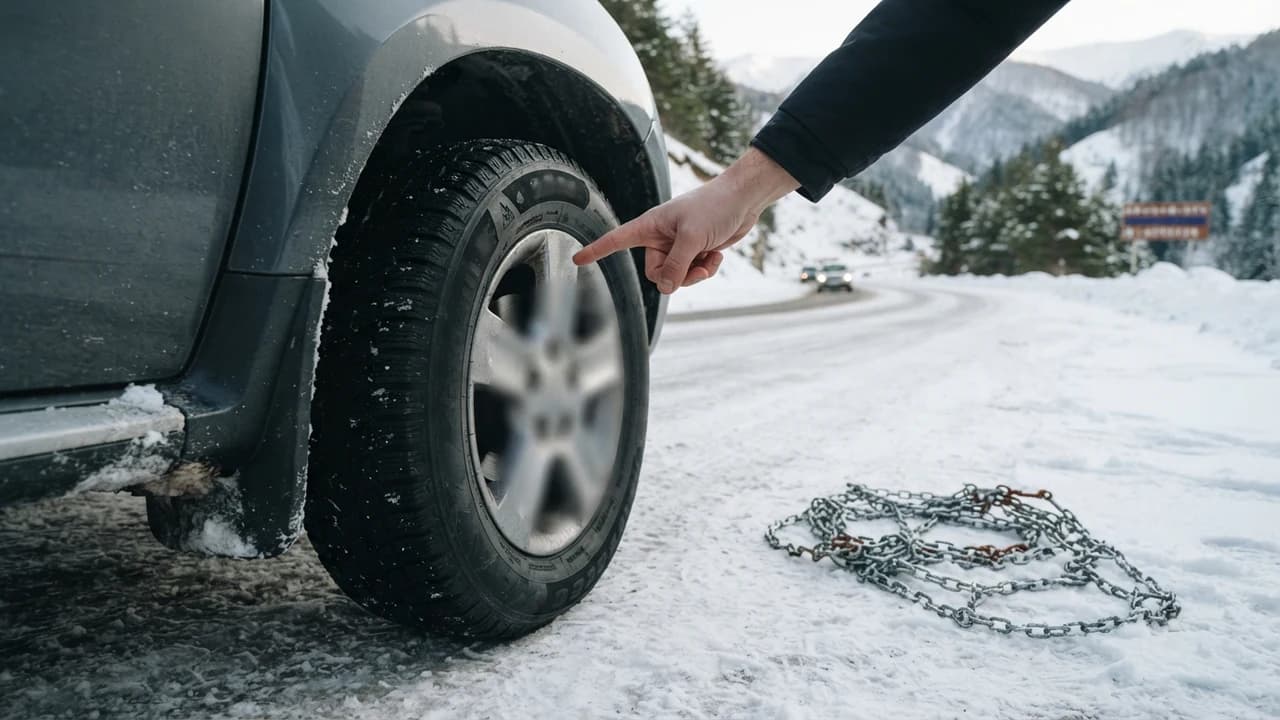
At pickup, check the tires in five steps: type marking, tread depth, pressure, chains and a trial fitting. The whole process takes 10–15 minutes and happens before departure — not on the road.
- Type. Look at the sidewall of all four tires: 3PMSF, M+S, studded or summer. All four should be the same type.
- Wear. Measure tread depth with a coin or ruler (below).
- Pressure. Ask the owner what pressure this specific car needs, and top up at a nearby station if required. Pressure drops in the cold.
- Chains. Make sure chains are in the trunk if your route crosses a mountain section.
- Photos. Photograph all four tires and record the fuel level for the handover act.
How to Check Tire Wear With a Coin
To check wear with a coin, insert it into a tread groove and see how much of it disappears. If the tread is shallow and most of the coin sticks out, the tire is worn. Tires also carry built-in tread wear indicators (TWI) — small bars that sit flush with the surface once the tire reaches its wear limit.
In winter, depth matters even more than in summer: it's the sipes that channel snow and water away from the contact patch. A worn winter tire behaves like a summer one on snowy patches. If the wear looks significant, raise it with the owner before starting your route.
Trial-Fitting Chains Before You Leave
Do a trial fitting of the chains before departure — somewhere dry and lit, such as a courtyard or parking lot. Fitting a chain for the first time under falling snow, at -10°C and in the dark, is a bad idea.
- Ask the owner whether the chains match this car's tire size.
- Try fitting one onto a single wheel without moving the car, just to check.
- Remember that chains go on the driven wheels (the front ones on a front-wheel-drive car), but check the exact instruction in the car's manual.
- When driving with chains fitted, keep your speed low — per the chain manufacturer's guidance.
Your Route and Current Rules: When Winter Tires or Chains Are Required
Whether winter tires or chains are mandatory on a given Armenian road is determined by current traffic regulations and the weather situation at the time. Those requirements can change, so before departure check them via the official Armenian Police source at roadpolice.am and government announcements at gov.am (verified as of publication date).
The practical rule is simple: if your route crosses a mountain pass or high-altitude stretch, winter tires are the minimum and chains are your safety reserve. The road to Tsaghkadzor, the Sevan pass and the Jermuk direction frequently see snow cover and ice in winter.
We can't state in this article the current closure status or requirements for specific roads — that changes with the weather. Your reliable sources are current announcements from the police and road services on the day you travel.
Price, Deposit and Insurance: What the Owner Decides
The price, deposit, insurance and tire terms of a rented car are decided by the vehicle's owner — through the listing and your agreement with them. JanCar is a connecting platform: it brings together listings from independent owners, has no fleet of its own, and doesn't set vehicle terms.
On deposits, the key boundary is this: JanCar does not receive, hold or guarantee any deposit. If a listing states a deposit, the money and its handling are arranged directly between renter and owner. Check the deposit amount on the listing and clarify return conditions with the owner before booking.
On insurance, the baseline is MTPL (ԱՊՊԱ) — Armenia's mandatory motor third-party liability insurance. Verify that it's valid and ask about its coverage with the owner at pickup. No conclusions can be drawn about any additional coverage without seeing the actual insurance policy. Details on insurance, deposits and the handover act are covered in a separate guide.
What to Clarify With the Owner Before Booking
Before booking, send the owner five specific questions covering tire type, wear, chains, your route and handover terms. Short, precise questions save time and reduce awkward moments at pickup.
- "What tires are on the car in winter — 3PMSF winter, M+S, or studded?"
- "Is the tread depth sufficient for a mountain route?"
- "Do tire chains come with the car, and do they fit the tire size?"
- "I'm planning to go to \[route\]. Is the car suitable for that route, and are there any restrictions?"
- "What's included in the price — mileage limit, fuel terms, deposit, pickup and return location and time?"
At pickup, agree on a clear time and place, photograph the tires, fuel level and existing damage, sketch a damage diagram, and sign the two-sided handover act. These steps are optional — but they're exactly what protects both sides from disputes at return time.
Frequently Asked Questions
Is an M+S Marking Enough for a Winter Mountain Route?
An M+S marking tells you the tire's intended category, but implies no passed snow test. For a winter mountain route, the 3PMSF symbol is the more reliable indicator. If the car only has M+S, clarify the tire's actual condition with the owner and how well it matches your route.
Where Do I Check Whether Winter Tires or Chains Are Mandatory on a Specific Road?
Check the official website of the Police of Armenia at roadpolice.am and government announcements at gov.am, as of your day of travel. Seasonal road requirements and closures change with the weather, so relying on old articles is risky.
Does JanCar Hold a Deposit for the Rental?
No. JanCar does not receive, hold or guarantee any deposit. If the owner states a deposit on the listing, the amount and its handling are arranged directly between renter and owner, by mutual agreement.
What Should I Do if the Tires at Pickup Don't Match the Listing?
Don't head up a mountain route on unsuitable tires. Discuss the situation with the owner before departing; possible solutions include a different car, a route change or revisiting the booking. Document the actual condition with photos and note it in the handover act.
Is It Worth Taking a Studded-Tire Car for a City Route?
If your entire route stays within Yerevan and flat roads, regular winter tires are usually enough, and the choice depends on what the owner's listing offers. Studded tires' advantage is on ice, but the decision comes down to combining your route with the owner's terms.
Official Sources
The following sources were used to verify facts, as approved in the brief.
Related Reading
Continue the topic with these verified related guides.
This is general information. JanCar does not receive or hold a vehicle deposit. Check price, deposit, insurance and every other term on the listing and directly with the owner.
Frequently asked questions
Is an M+S Marking Enough for a Winter Mountain Route?
An M+S marking tells you the tire's intended category, but implies no passed snow test. For a winter mountain route, the 3PMSF symbol is the more reliable indicator. If the car only has M+S, clarify the tire's actual condition with the owner and how well it matches your route.
Where Do I Check Whether Winter Tires or Chains Are Mandatory on a Specific Road?
Check the official website of the Police of Armenia at roadpolice.am and government announcements at gov.am, as of your day of travel. Seasonal road requirements and closures change with the weather, so relying on old articles is risky.
Does JanCar Hold a Deposit for the Rental?
No. JanCar does not receive, hold or guarantee any deposit. If the owner states a deposit on the listing, the amount and its handling are arranged directly between renter and owner, by mutual agreement.
What Should I Do if the Tires at Pickup Don't Match the Listing?
Don't head up a mountain route on unsuitable tires. Discuss the situation with the owner before departing; possible solutions include a different car, a route change or revisiting the booking. Document the actual condition with photos and note it in the handover act.
Is It Worth Taking a Studded-Tire Car for a City Route?
If your entire route stays within Yerevan and flat roads, regular winter tires are usually enough, and the choice depends on what the owner's listing offers. Studded tires' advantage is on ice, but the decision comes down to combining your route with the owner's terms.
Where to go next
Sources
- police.am gov.am
police.am · official source