Overtaking on Narrow Mountain Roads: When to Say No
Overtaking on a narrow mountain road is a decision made in seconds. This guide gives you clear criteria for when to abandon the manoeuvre, plus a practical checklist to run through before you even get behind the wheel.
8 min read
In this article
Overtaking on a narrow mountain road is a decision made in seconds. This guide gives you clear criteria for when to abandon the manoeuvre, plus a practical checklist to run through before you even get behind the wheel.
On a narrow mountain road, you should refuse to overtake every time there's a prohibiting sign, you can't see the oncoming lane in full because of a curve or crest, or you don't have enough space and time. Waiting for a straight, fully visible stretch is always the safe choice. It matters even more in a rented car, whose acceleration, brakes and dimensions you haven't yet learned to feel.
Key Takeaways
- Prohibiting sign, solid (continuous) marking or closed sight line — overtaking isn't just risky there, it's impermissible.
- Overtaking on a curve or crest is prohibited by Armenia's traffic rules regardless of whether a sign is present.
- Wet, snow-covered or gravel surfaces, a heavy load and a small speed differential — each one on its own is reason enough to hold back.
- In a rented car, add extra margin: you don't yet know what that particular car can do.
- JanCar only connects renter and owner; the car's condition, insurance and deposit terms are set by the owner in the listing.
When Overtaking Is Simply Not Allowed
Some situations aren't "risky" overtaking — they're outright forbidden by law or physically impossible. In these three cases, the manoeuvre isn't even up for discussion.
Prohibiting Signs and Road Markings
Within the zone of an "Overtaking prohibited" sign, the manoeuvre is illegal. Such signs are often placed precisely at dangerous mountain sections, near curves. A continuous (solid) marking also forbids crossing into the opposing lane.
Check the current text of the traffic rules and signage on the official roadpolice.am website or in the arlis.am legal database. At the time of publishing, we verified the rules against those sources — but keeping your knowledge current is your responsibility. We won't quote exact fine amounts here, since they change.
Closed Sight Line: Curves and Crests
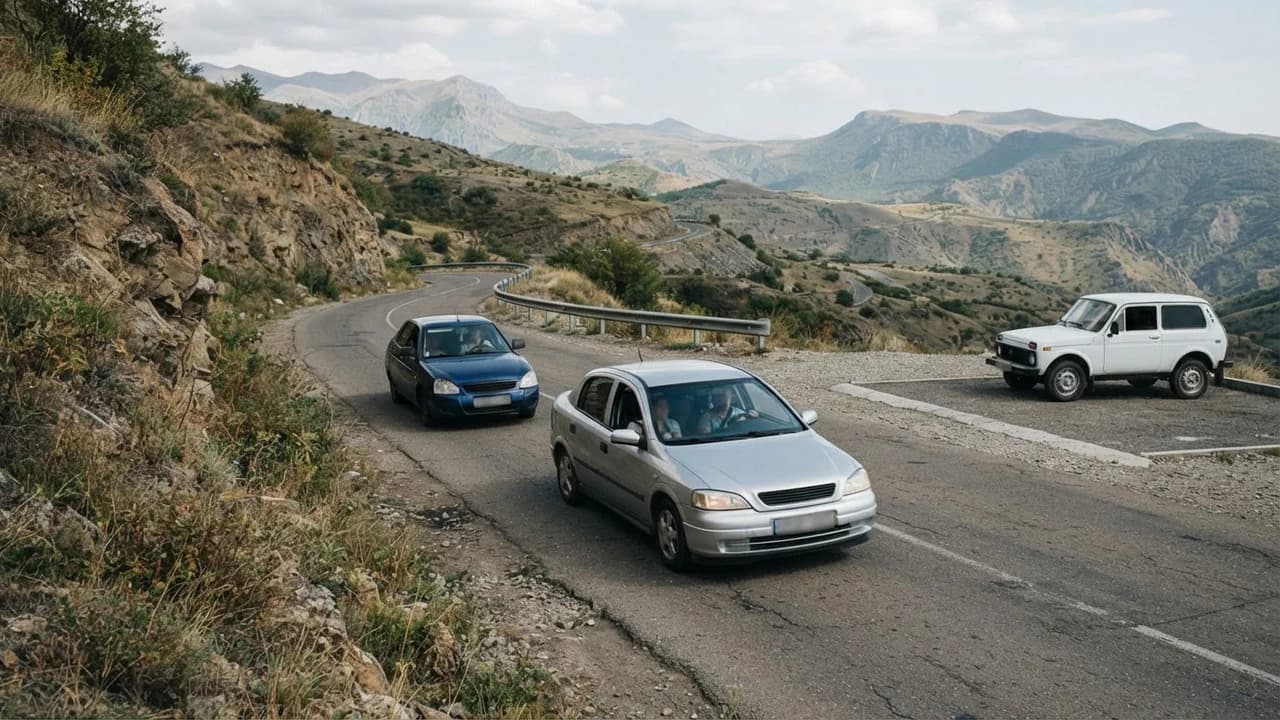
Overtaking on a curve or at the top of a hill is prohibited — you can't see what's coming toward you. The practical rule is simple: overtake only when the oncoming lane is visible for the entire length of the manoeuvre. If in doubt, don't do it.
On typical stretches of the Selim (Vardenyats) pass or the Dilijan–Vanadzor road, curves follow one after another. There you may realistically wait several kilometres for a straight, wide section. That's not lost time — it's normal mountain driving.
When It's Better to Hold Back: Risk Criteria
Even when the law technically permits it, there are conditions under which an experienced driver declines the manoeuvre. Each factor below is sufficient on its own not to start.
Bad Weather and Wet Surface
Rain, fog, snow or a wet surface? Refuse the manoeuvre. Braking distances stretch, visibility shrinks, and the "price" of a mistake at the edge of a mountain road is incomparably higher. In winter, conditions on the passes can change within hours — check the road status before departure on the Ministry of Territorial Administration and Infrastructure's armroad.am website.
A Loaded Car and Insufficient Space
A full boot, five passengers, the whole family aboard — the car accelerates slowly and brakes long. Add a small speed differential: if the car ahead is only 10–15 km/h slower, the overtake takes ages and demands far more clear road. Where shoulders are narrow or absent, an oncoming car has nowhere to retreat — another reason to wait.
Step-by-Step Checklist Before the Manoeuvre
Run through this list in the few seconds before starting the manoeuvre. If even one item is a "no", the manoeuvre waits.
- Signs and markings: Is there a prohibiting sign? A solid line ahead? Not allowed.
- Sight line: Can you see the oncoming lane all the way to the end of the manoeuvre, on a straight section?
- Oncoming traffic: Any car visible on the horizon — even as dust or headlights?
- Surface and weather: Dry? Clear?
- The car and its load: Enough acceleration for this load, in this car?
- Escape route: If the manoeuvre fails, where do you retreat to? Is the shoulder wide enough?
Renters add a seventh item: have you already felt this car's acceleration and brakes? In the first hours the answer is usually "no", so widen your margin by at least 20–30 percent compared with your own car.
Typical Mistakes and Main Risks
The most common mistake is misjudging distance: in mountain air, an oncoming car looks "closer" than it really is, while the road needed for the manoeuvre seems shorter. The second mistake is rushing downhill — speed creeps up unnoticed while the brakes heat up.
The third risk is the "half-open" sight line: just past a crest the road may look straight, but as the next crest comes into view, visibility closes again. And the most dangerous mistake is psychological: when the car ahead slows down "as if letting you pass", and the driver feels social pressure. A follower can't force you — and you make no decision on anyone else's schedule.
What to Clarify in Advance with a Rented Car
A mountain route starts not on the road but at the listing. JanCar is a peer-to-peer platform: it only connects the renter with an independent owner (host), and the car's condition, price, mileage limit and insurance are set by the owner in the listing.
To be especially clear: JanCar does not receive, block or hold any deposit. If the owner states a deposit, its size and form are agreed directly between renter and owner, without the platform's involvement.
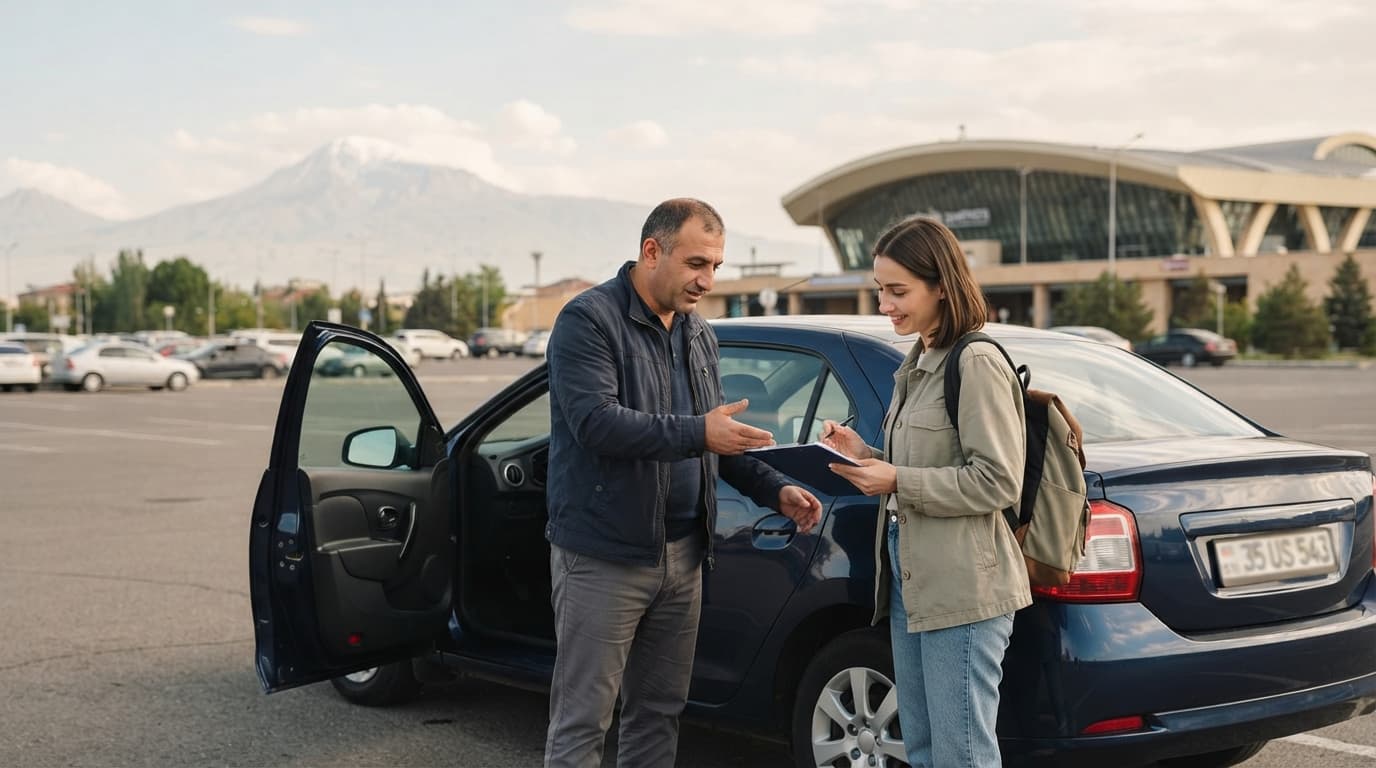
At handover, a few simple steps are worth doing: photograph the car's condition, record the fuel level, mark existing damage on a diagram, and sign a handover act with both signatures. Ask to see the current insurance policy and find out what it actually covers — coverage can't be assumed. For mountain routes, also confirm which class the car belongs to and whether the owner restricts certain roads.
The Safe Alternative: What to Do Instead
Refusing creates no problem at all if you know what to do instead. First: simply wait — a straight, visible section arrives, sometimes within two or three minutes. Second: use designated pull-offs or wide shoulders; on mountain roads these are often marked, and followers can pass there where it's safe.
Third: plan stops in advance. If you know you're taking the Selim pass, choose your departure time so you're not in a hurry. Checking road status before departure on armroad.am and roadpolice.am should be a habit, not an emergency measure.
Rule of thumb: if you only start thinking about whether to overtake as you approach the curve, that manoeuvre is already too late.
Frequently Asked Questions
Is overtaking on a curve allowed if no car is visible?
No. Overtaking on a curve is prohibited by traffic rules regardless of whether an oncoming car is visible. The lack of visibility is the very reason for the prohibition — "nothing there right now" doesn't mean nothing will appear mid-manoeuvre.
What if the driver ahead slows down and seems to let me pass?
Overtake only if every item on your checklist says "yes". Someone else's permission doesn't change the sight line, the surface or what your car can do. If in doubt — you don't overtake, and that's not rude in any way.
Are mountain routes banned for rented cars on the platform?
JanCar sets no such ban. Road restrictions, if any, are stated by the owner in the listing or agreed directly. Before heading to a pass, confirm this with the host and check the insurance policy.
Related Reading Paths
Continue the topic with these verified related guides.
- Driving over a Snow-Covered Pass: When to Change Your Route
- Checking Road Conditions in Armenia: Where and When
This is general information. JanCar does not receive or hold a vehicle deposit. Check price, deposit, insurance and every other term on the listing and directly with the owner.
More JanCar guides
Continue with these closely related practical guides.
- Engine Braking on Mountain Descents: A Practical Guide
- Replying to a Car Rental Inquiry: A Practical Guide
- Night Driving on Armenia's Mountain Roads
- Driver Fatigue on Mountain Roads: A Practical Guide
- Yerevan to Tsaghkadzor by Rental Car: A Practical Route Plan
- Rental Car to a Hiking Trailhead: Checklist
Frequently asked questions
Is overtaking on a curve allowed if no car is visible?
No. Overtaking on a curve is prohibited by traffic rules regardless of whether an oncoming car is visible. The lack of visibility is the very reason for the prohibition — "nothing there right now" doesn't mean nothing will appear mid-manoeuvre.
What if the driver ahead slows down and seems to let me pass?
Overtake only if every item on your checklist says "yes". Someone else's permission doesn't change the sight line, the surface or what your car can do. If in doubt — you don't overtake, and that's not rude in any way.
Are mountain routes banned for rented cars on the platform?
JanCar sets no such ban. Road restrictions, if any, are stated by the owner in the listing or agreed directly. Before heading to a pass, confirm this with the host and check the insurance policy.
Where to go next
Sources
- JanCar — how it works
jancar.am · official source
- JanCar car catalogue
jancar.am · official source