
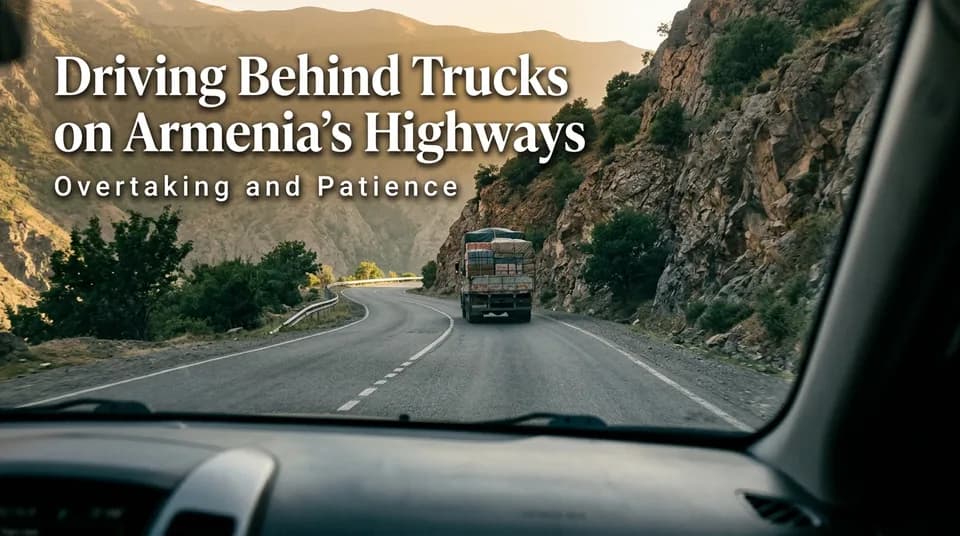
Driving Behind Trucks on Armenia's Highways: Overtaking and Patience
Stay well back from a truck, and overtake only when the road is long, straight and fully visible. Here is the order of decisions to run through on a mountain road.
6 min read
In this article
Keep a big gap behind a truck, big enough that you can see the road past its side and still have room to brake. Overtake only on a long, straight stretch where you can see everything ahead, and if you're in doubt, wait. Driving behind trucks on Armenia's highways takes patience, and losing a few minutes is always cheaper than a bad overtake.
On the Sevan–Dilijan, Yerevan–Gyumri and Yerevan–Meghri routes, truck traffic is steady, and on mountain sections the trucks crawl. On a road like this, the most useful thing is a simple order of decisions: distance, visibility, climbing lane, give up.
Behind a truck: how far back should you stay?
A safe distance is one where you can see the road ahead of the truck and still have time to brake if it suddenly slows. On dry, straight tarmac the usual advice is the "two-second rule". That's a driving-practice tip, not a figure from the law. On wet or snowy roads, or on a descent, leave more room, because braking distance grows there.
Tailgating is dangerous for another reason too: right behind a truck, the road ahead of you is blocked from view, and stones and dust can fly up from under its wheels.
How to tell you're too close
You're too close if all you can see ahead is the truck's body, if you keep having to brake, or if you hear stones hitting your windscreen. Another sign: you can't see the road markings in front of the truck. In that case, just drop back.
The mirror rule: if you can't see his mirror, he can't see you
Around the rear and sides of a truck there is a blind spot where the driver can't see you. If you can't see his side mirror from where you sit, he can't see you either. Don't tuck in right behind the trailer or alongside it. Stay where you show up in his mirror.
Before you overtake: what you need to see
Overtaking is allowed only when the road ahead is long and straight, the oncoming lane is clear, and the markings and signs permit it. If even one of those is doubtful, don't start.
The spots that rule out overtaking are well known: a bend, a crest, a junction, a tunnel, a bridge. Near any of them, you can't see what's coming in the oncoming lane.
Markings and signs: where overtaking is banned
Road markings and signs are the main instruction for overtaking. A solid line, a "No overtaking" sign and narrow sections end any calculation. Check the exact provisions on arlis.am, in the current text of the road traffic safety law and the relevant Government decision. There are also official explanations on the Road Police website. Check fine amounts there as well, since rules change.
Why a truck's length adds to your overtaking time
A truck, or a vehicle towing a trailer, is long, so you spend more time in the oncoming lane than you would passing a car. If the speed difference is small, the overtake drags on. Count not only the truck but also the vehicles ahead of it.
Climbs and extra lanes
Some climbs have an extra lane, but not all of them do. Use it only as the markings and signs direct. If there are no signs, don't assume the lane gives you any right to pass. Check specific stretches beforehand in an official source or on a map.
A climbing lane is normally meant for slow heavy vehicles, so that everyone else can get by. It's especially useful on the long climbs in Syunik and on the Sevan–Dilijan section.
What to do when there's no extra lane
If there's no lane, stay behind and don't try to squeeze past before a bend. Wait for the first long straight, or for a place where the road widens. Remember, your horn or flashing headlights won't make a truck go faster, but they can rattle the driver.
Descents: why a truck can suddenly speed up or overheat its brakes
On a descent a truck gathers speed under its own momentum, and its brakes heat up from long braking. That's why its speed can change without warning. Keep more distance than usual, and don't try to overtake on a descent if the truck has already picked up speed.
When to give up on overtaking
Give up every time you aren't sure you can get back into your lane safely. Warning signs are fog, night, snow or ice, sharp bends, a tunnel, damaged tarmac, a convoy of trucks and fast oncoming cars. On winter mountain passes, these often turn up together.
A give-up checklist: 5 questions
If the answer to even one of these is "no", don't start the overtake.
- Can I see the road ahead all the way to the end of the manoeuvre?
- Is the oncoming lane clear?
- Do the markings and signs allow it?
- Are visibility, road surface and weather all fine?
- Does the car have enough power to pass quickly?
What to do if you've started and realise you won't make it
If you've already pulled out and can't make it, pick the calmest way out. Ease off the gas and go back into your lane, behind the truck if you can. Only if that gap is closed, brake in a controlled way, without yanking the wheel to the left.
In a rental car: what to settle beforehand
A rental car's power and gearbox may differ from what you're used to, and that directly affects overtaking. A weak engine accelerates slowly on a climb, and an automatic transmission sometimes hesitates to drop a gear. Find this out before you set off.
For a long mountain route you might also consider renting with a driver if you don't feel confident yourself. JanCar is a classifieds board where cars are listed with a driver or without one, and you call the owner directly. The owner agrees the terms with you, not the platform.
What to ask the owner on the phone
- What engine does the car have, and how does it cope with mountain climbs?
- Is the gearbox automatic or manual?
- Are trips to Sevan, Dilijan or Syunik allowed, and is there a mileage limit?
- What condition are the tyres and brakes in?
The price, the security deposit (if the owner asks for one) and the other terms are agreed directly between the two sides. JanCar doesn't receive or hold a deposit. Don't pay anything in advance before you've seen the car and checked its documents.
Frequently asked questions
How far back should I stay behind a truck?
On a dry, straight road the usual advice is the "two-second rule". That's a practice tip, not a figure from the law. On wet or snowy roads and on descents, leave more room.
Can I overtake a truck on a climb?
Only if the road is long and straight, the oncoming lane is clear, and the markings and signs allow it. Some climbs have an extra lane, but not all, so watch the signs.
Where can I check the official overtaking rules?
On arlis.am, Armenia's legal database, in the current text of the road traffic safety law and the relevant Government decision. There are also explanations on roadpolice.am.
Where to go next
- Overtaking on a narrow mountain road: when to give up the manoeuvre — goes deeper on the "when to give up" section for narrow mountain stretches.
- Driving through tunnels in Armenia: lights, speed and distance — distance and overtaking work differently in tunnels.
- Driving in fog in the mountains: rules and a checklist — fog is one of the main reasons to give up an overtake.
- Night driving on Armenia's mountain roads — at night, visibility for overtaking drops sharply.
- Renting a car from an owner: how JanCar works — shows how to find a car and call the owner to confirm engine power and gearbox.