
Gravel Road in a Rental Car: Push On or Turn Back?
Hitting a gravel section in a rental car is a decision, not a disaster. Four factors, five steps, and you'll know whether to keep going or change your route.
8 min read
In this article
Hitting a gravel section in a rental car is a decision, not a disaster. Four factors, five steps, and you'll know whether to keep going or change your route.
If you reach a gravel stretch in a rental car, the decision comes down to four factors: the listing's restrictions, the car's ground clearance and tires, the road's current condition, and whether you can safely turn around. If even one of them looks doubtful, change your route. Below is a 5-step checklist that lets you decide within minutes.
Key Takeaways
The go/no-go call sits at the intersection of four factors, not just "driving experience." Any one of them can stop the trip on its own.
- The listing. If the owner (host) has restricted gravel or rural roads, you can't go without their explicit agreement.
- The car. A sedan with low clearance and summer tires on a mountain gravel stretch is a risk regardless of your skill.
- Condition. After rain or snowmelt, the same road can be passable yesterday and impassable today.
- Turning around. If the stretch is narrow with nowhere to turn, decide your exit before entering — not halfway in.
JanCar is a connecting platform: the car, price, deposit, insurance, and handover terms are set by the listing, by the owner, and by the contract. The platform does not receive or hold the deposit.
What Counts as a Gravel Road, and Why It Demands a Decision
A gravel road is any stretch without asphalt-concrete pavement — or where it has badly deteriorated — so traffic runs on gravel, crushed stone, or dirt. In a rental car it demands a deliberate decision because the risk of damage, and with it your liability, is tied to the contract terms.
The difference between gravel, rough, and mountain roads
- Gravel. Regularly maintained dirt or gravel surface, usually on approaches leading into villages. Passable in a normal car in dry weather.
- Rough. Broken asphalt or potholed sections — the kind you find on side branches off the Tatev–Goris route. Risk depends on speed and clearance.
- Mountain rural. Steep, narrow, possibly without guardrails. Some roads around Dilijan and certain Jermuk approach roads fall into this category.
All three demand different decisions. The same car might handle the first easily, cross the second carefully, and have no business on the third at all.
Step 1: Check the Listing Restrictions
Listing restrictions are the first filter of the decision: if the owner has banned gravel roads, the question is closed until you agree otherwise in writing. Open the listing on JanCar and look for two things — the permitted-area clause and any specific notes about roads.
If nothing is written in the listing, that isn't permission either. Ask the owner before departure and secure the answer in writing through the platform's messaging. A verbal yes protects you not at all if a dispute arises.
Step 2: Assess the Car's Ground Clearance and Tires
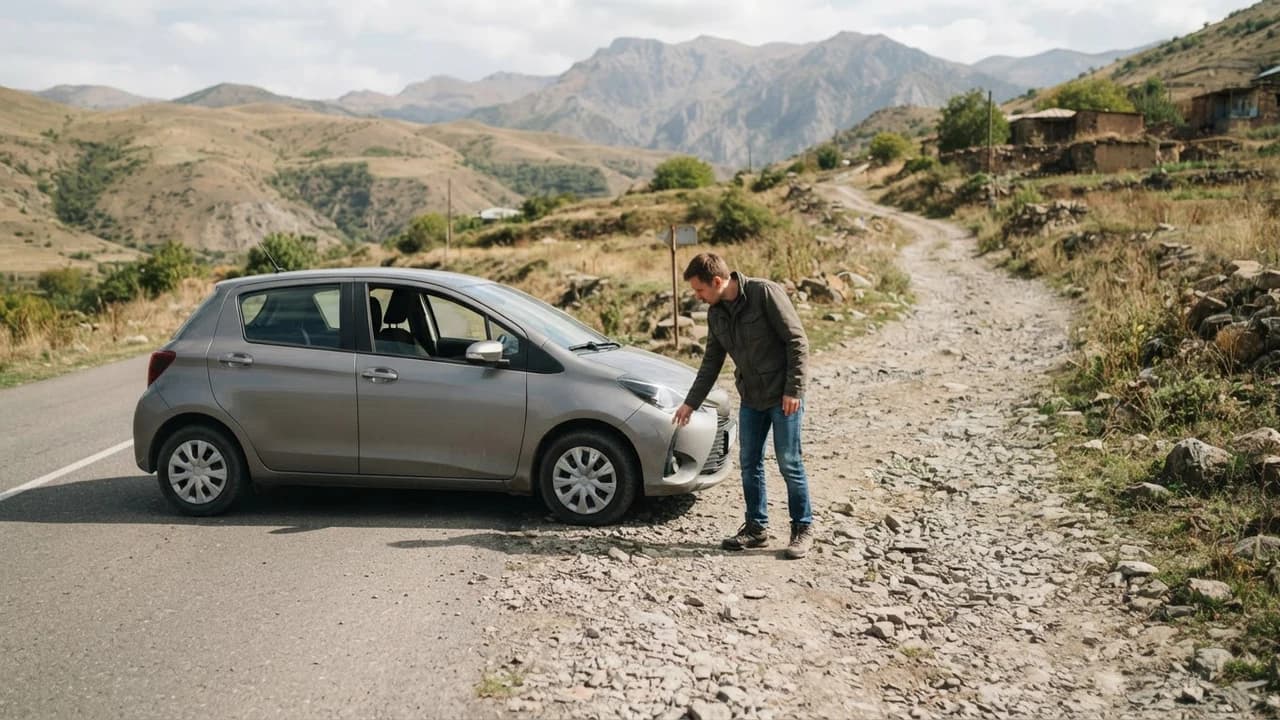
Clearance and tires determine whether the car can physically make it through the stretch without scraping its underbody or sliding. Ground clearance is the distance between the road surface and the car's lowest point; the deeper the potholes and rocks, the more clearance you need.
- Clearance. City sedans usually sit low; on a potholed gravel stretch the odds of bottoming out rise sharply. A crossover or SUV gives you a bigger margin.
- Tires. In winter and late autumn, winter tires are required on mountain stretches during the periods set by law. Check the tire type before departure and ask the owner.
- Spare tire and tools. Tire damage is likelier on gravel. Confirm the spare and basic tools are actually in the car.
Step 3: The Road's Current Condition — What to Verify and Where
Road condition is a moving target: check it on the day you leave, not based on an article you read weeks ago. Rain, snowmelt, or construction can flip the picture overnight.
- Weather. For mountain stretches, check the forecast from Armenia's Hydrometeorological Service at meteomonitoring.am on your departure day.
- Road restrictions. Closures and construction zones — check the Armenian Police site roadpolice.am and the government portal gov.am.
- Locals. The freshest information about rural branches often comes from locals. Ask along the way, or ask the owner if they're local.
This article does not confirm any road conditions. Verify the sources on the day of publication of your trip — data changes.
Step 4: Can You Safely Turn Around?
Judge your ability to turn around before entering, not mid-way. If the stretch is narrow, sloped, or blind ahead, turning around may be riskier than continuing.
- Width. Is there a spot where the car can turn in three moves without ending up at the edge of a pothole or ravine?
- Visibility. Will an oncoming car see you in time, or will you meet it mid-blind-curve?
- Slope. Turning on a gradient takes more space and a calm hand behind the wheel.
If there's no safe place to turn nearby, that itself is the answer: don't enter such a stretch unless you're confident it's passable.
Step 5: The Decision Checklist — Go, or Change Route?
Make the call with a table: "yes" or "no" for each of the four factors.
Factor
Go
Change Route
Listing
Gravel allowed, or agreed in writing
Banned, or neutral/unknown
Clearance and tires
Adequate clearance, suitable tires, spare present
Low clearance or wrong tires for the season
Condition
Dry weather, no restrictions in official sources
Rain/snowmelt, closure, or construction
Turning around
A safe turn-around spot exists nearby
Narrow, sloped stretch with no exit
The rule is simple: if even one row says "change route," change it. One side branch isn't worth the risk of a crash, damage, or a dispute with the owner.
Safe alternatives and the next step
When looking for an alternative, stick to the main paved routes: the main highway toward Tatev and Goris, the trans-republican road to Dilijan, and the main approach to Jermuk are usually better maintained than the side branches.
If your plan depends on exactly that rural destination, another option is choosing a car suited to the route at the booking stage — checking ground clearance and listing terms in the JanCar catalog. It's cheaper than standing on the road in the wrong car.
In case of damage, coverage depends on the contract and the owner's insurance policy: verify the policy exists and review the contract terms before departure. What to do if something goes wrong on the road is a separate topic, with its own step-by-step instructions.
Frequently Asked Questions
Can I take a rental car on a rural road?
Yes, if three conditions hold together: the owner allows it in the listing or in writing, the car has adequate clearance and suitable tires, and the road's current condition is passable. If any one is missing, change your route.
Why does ground clearance matter on a mountain road?
Because on mountain gravel stretches, potholes, rocks, and runoff physically strike the underside of the car. Low clearance means a risk of damaging the suspension, brakes, or oil pan — and in a rental, damage ties back to liability.
What role does JanCar play in this decision?
JanCar is an intermediary platform: cars belong to independent owners, and road restrictions, price, deposit, and insurance are set by the listing and the contract. The platform does not receive or hold the deposit; if the owner specifies one, it's arranged directly between them and the renter.
Related Search Paths
Continue the topic with these vetted related guides.
This is general information. JanCar does not receive or hold a vehicle deposit. Check price, deposit, insurance and every other term on the listing and directly with the owner.
More JanCar guides
Continue with these closely related practical guides.
Frequently asked questions
Can I take a rental car on a rural road?
Yes, if three conditions hold together: the owner allows it in the listing or in writing, the car has adequate clearance and suitable tires, and the road's current condition is passable. If any one is missing, change your route.
Why does ground clearance matter on a mountain road?
Because on mountain gravel stretches, potholes, rocks, and runoff physically strike the underside of the car. Low clearance means a risk of damaging the suspension, brakes, or oil pan — and in a rental, damage ties back to liability.
What role does JanCar play in this decision?
JanCar is an intermediary platform: cars belong to independent owners, and road restrictions, price, deposit, and insurance are set by the listing and the contract. The platform does not receive or hold the deposit; if the owner specifies one, it's arranged directly between them and the renter.
Where to go next
Sources
- JanCar — how it works
jancar.am · official source
- JanCar car catalogue
jancar.am · official source