
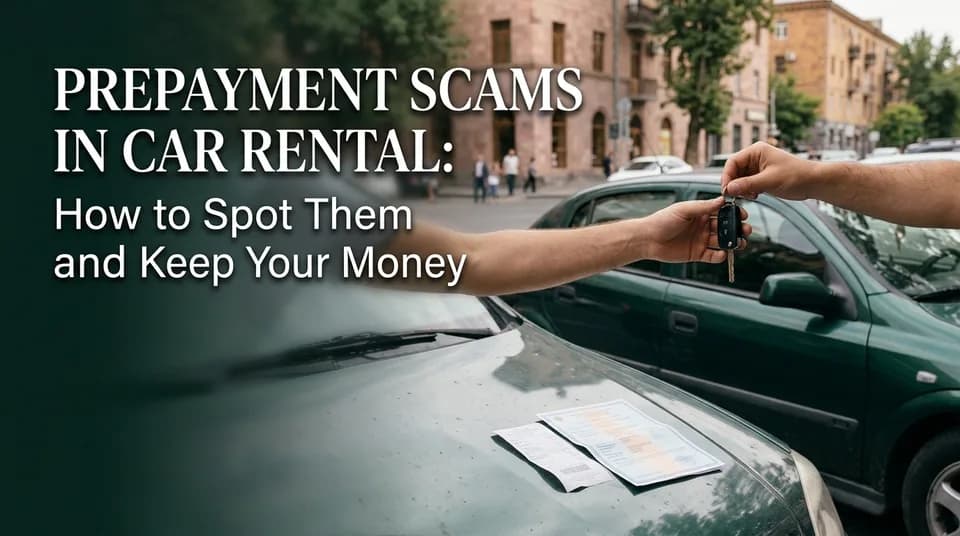
Prepayment Scams in Car Rental: How to Spot Them and Keep Your Money
Money sent to a card before you've seen the car and its documents is the number one sign of a scam. Here are six warning signs, the checks to run, and what to do if you've already paid.
9 min read
In this article
A prepayment scam in car rental means someone asks you to send money to a card, pay through a link or read out a card code before you've seen the car and its documents. JanCar doesn't take payments between renter and owner, so you pay only when you pick up the car, and only against a written receipt.
This guide shows how a legitimate rental differs from a scam, what to say to the owner, and what to do if the money has already gone. There's no need to be afraid. A few simple rules stop almost every scheme.
Key takeaways
- Don't transfer anything until you've seen the car and its documents, not even "to hold the car".
- JanCar has no online payment, booking or chat. Anyone saying "pay through JanCar" is lying.
- No real owner asks for an SMS code, a CVV or a PIN.
- Pay at pickup, against a written receipt that lists the rental fee and the deposit separately.
- If you've already sent money, call your bank the same day and report it to the police.
How a prepayment scam works on a classifieds board
The scammer posts an attractive ad but has no car. What they want is the money you send, not a rental. The schemes are few, and they repeat.
- A transfer to a card "to hold the car". They say other people are in line and the car won't be held without a prepayment.
- A fake ad. The photos may be lifted from another listing, and the car in the description doesn't exist.
- A fake page, or a message "from the platform". They send a payment link, or claim "the platform will hold the money".
The JanCar flow is simple. You filter the catalog, open an ad, sign in, see the owner's phone number and call. Price, deposit, insurance, mileage and pickup are all settled directly with the owner.
Why your own checks matter in a direct-deal model
JanCar is a classifieds board. It doesn't verify the owner's identity, take part in the payment or guarantee the deal. So the key checks are yours to make: by phone, at the meeting and through the receipt. They're not hard if you keep to the right order.
Six signs the ad or the owner is suspicious
One sign is enough to be wary: a request to pay to a card, a price that's too low, pressure to hurry, a refusal to meet, links or codes, a sudden change. Two together are already a reason to walk away.
- Money to a card before you've seen the car.
- A price far below similar ads.
- Pressure to hurry.
- A refusal to meet or to show documents.
- Payment links and requests for card codes.
- A sudden change of person or car.
A price far below comparable ads
Before you call, open three or four other ads in the catalog for the same class of car, the same city and the same kind of rental. If one price sits well below the rest, ask why. A good reason is specific, like an older car or a mileage limit. "It's just a good deal" is not a reason.
"Hurry, other people are calling"
Pressure is the scammer's main tool, because it leaves no time to check. A real owner will wait a day while you come and see the car. If they insist on "transfer now or lose it", walk away calmly.
A refusal to meet or to show documents
An owner who won't meet you and won't show the vehicle registration certificate can't sign a rental agreement. "I'm out of town, my friend will bring the keys" is already an alarm bell. The normal setup is a meeting at the car or at an agreed place, for example Zvartnots International Airport, if the ad lists that option.
Payment links and card codes
Opening a "payment page" from a stranger's link, or reading out a code you've been sent, is not how you receive money. It's how money leaves your account. There is no such page on JanCar.
A sudden change of person or car
You called one person and a different one turns up. Or instead of the car in the ad you're offered "the same one, only better". That's a substitution, not an adjustment. Agree a deal only for a car you've seen and whose documents you've held in your hands.
What never to do: card details, codes and payment links
JanCar never asks for card details and never accepts payments, so any payment request "from JanCar" is fake. That applies to emails, messages and phone calls alike.
SMS code, CVV and card PIN: never
An SMS code is a one-time password sent by your bank. The CVV is the three digits on the back of the card, and the PIN is the card's secret code. An owner needs none of them to receive money. If someone asks for them, your card is at risk. You can find current information on card security on the Central Bank of Armenia website, and for specific rules ask your own bank.
People writing "on behalf of JanCar" and fake pages
If someone writes to you "on behalf of JanCar" and asks you to pay, sends a "booking link" or mentions a "platform that holds the deposit", that's a scam. JanCar has no booking, no deposit holding and no chat. Contact with the owner is by phone. Report any such message through the support form.
How to check the owner and the car before you pay
The most reliable check is meeting at the car with the documents in hand. Talk about money only after that. The steps:
- Meet at the car, in daytime, in a busy place.
- Ask to see the vehicle registration certificate and the owner's ID document.
- Compare the name, make and plate number with the ad.
- If the certificate shows a different name, ask for an explanation and written confirmation.
- Photograph the car from every side, and the fuel gauge.
What to ask on the first phone call
On the first call, get the facts before any talk of money. Useful questions:
- "Can we meet at the car so I can see the registration certificate?"
- "Is a deposit required, and how much?"
- "Do I pay at pickup? Will you give me a receipt?"
- "Is the car in the ad free on that exact day?"
Write the answers down. If the owner changes the terms later, your notes will help.
The "Verified" badge: not an inspection, not a guarantee
The "Verified" badge means one thing: at moderation, JanCar checked the car's registration certificate. It isn't a technical inspection of the car, it isn't a check of the owner's identity and it isn't a guarantee. It's a useful signal, but you still check the documents yourself at the meeting.
How to pay safely: only at pickup, against a written receipt
Pay after you've seen the car and its documents, at pickup, and against a written receipt. Until then, no transfer is your obligation. The deposit is money the owner holds against possible damage and returns afterwards. JanCar doesn't receive or hold it, and the two sides arrange it directly.
What the receipt should say
A receipt is short, but it should include:
- the date and the names of both parties;
- the car's make and plate number;
- the amount paid, with the rental fee and the deposit on separate lines;
- the rental period, the mileage limit and the return place;
- the condition for returning the deposit;
- both signatures.
If you have a more detailed contract, go through it point by point, and don't rush to sign the rental agreement.
If the owner insists on a prepayment
Some owners do ask for a prepayment. That's their personal condition, not a JanCar rule. Your rule stays the same: the car and the documents first. Say it calmly: "I'll pay when I collect the car, against a receipt." If they insist on a card transfer, simply decline and keep looking. The catalog has hundreds of other options.
If you've already sent the money: step by step
If you've already sent money, the first step is to call your bank right away, and the second is to go to the police. The sooner the better, but nobody can guarantee a refund.
- Call your bank, say you're a victim of fraud and ask whether the transaction can be stopped.
- If you gave out a code or card details, ask them to block the card.
- Report it to the police. The way to do that is on the Armenian Police website.
- Don't send anything more, even if they promise a refund "for a small fee".
What evidence to keep
Don't delete anything, and don't block the person until you've saved everything. You'll need:
- the transfer receipt or bank statement;
- the whole correspondence or all messages;
- the ad link and a screenshot;
- the owner's phone number and the card number they gave;
- the times of the calls.
Why JanCar can't refund the money
JanCar never received or held your money. It went straight to the scammer's card. So the platform can't return it, and nobody else can promise a refund either. JanCar can only review the ad and, where needed, remove it.
How to report a suspicious ad on JanCar
Report a suspicious ad through the JanCar support form, choosing the topic "Problem with an owner or an ad". Give enough detail for an admin to find the ad quickly:
- the ad link;
- the owner's phone number you called;
- a short description of what they demanded and how;
- if you have it, the card number they asked you to send money to.
Admins review new ads in advance, but your report helps clear the board for everyone else. When you search for a new ad, pick your city in the catalog and use the "Verified" filter, remembering that it isn't a guarantee.
Frequently asked questions
Do I have to pay a prepayment when renting a car?
Neither the law nor JanCar's rules require it. A prepayment is the owner's personal condition. Your rule: transfer nothing until you've seen the car and its documents, and pay at pickup against a written receipt.
What should I do if I sent money to a card and the owner has disappeared?
Call your bank right away, then report it to the police, and keep the receipt, the correspondence and the ad link. A refund isn't guaranteed. Also report the ad through JanCar's support form.
Can JanCar return money sent to a scammer?
No. JanCar never receives, blocks or holds rental money or a deposit. The money went straight to the scammer, so the platform can't return it.
How do I check a car owner?
Meet at the car and ask to see the registration certificate and an ID document. Compare the name, make and plate number with the ad, photograph the car, and only then talk about payment.
Does the "Verified" badge mean the owner is trustworthy?
No. The badge means JanCar checked the car's registration certificate at moderation. It isn't a check of the owner's identity, an inspection of the car or a guarantee.
Where to go next
- Car rental payment methods in Armenia — see how owners are usually paid.
- Card hold on a car rental: what it means — tell a legitimate hold from a prepayment transfer to a card.
- Car rental deposit in Armenia: what to settle before you pay — a deposit is often requested under the name of a "prepayment".
- Sharing documents safely in car rental — how to be careful when you're asked for photos of your documents.
- Checking a car rental agreement: 12 points — a written agreement is the main protection against fraud.
- Checking the final settlement of a car rental: 7 points — check the amounts when you return the car.
- Car rental dispute evidence for owners — what evidence a party keeps in case of a dispute.
- Fake Car Rental Ads: How to Spot Them from the Photos, the Price and the Owner's Behavior
- Stargazing by Car at Night: How to Reach Dark-Sky Spots Safely
- Car Rental Cancellation Terms: What to Keep