
Renting a Gas-Powered Car in Armenia: Pros and Limits
A gas car usually saves money on fuel, but it cuts into trunk space and limits where you can fill up outside Yerevan. Here's what to check before you rent.
7 min read
In this article
Renting a gas-powered car in Armenia usually lowers your fuel bill, but it comes with trade-offs: a smaller trunk, uneven gas station coverage in the regions, and a weaker pull on climbs. On JanCar you find these ads with the "Gas" fuel filter. How the car is filled, and whether it can run on petrol too, you need to confirm with the owner.
What "gas car" means in JanCar ads
It means the owner picked gas in the fuel-type field. Usually that's compressed natural gas (CNG), but ask which gas it is when you call. Many cars are dual-fuel, gas plus petrol, though the filter won't tell you that.
JanCar is a classifieds board. You open an ad, sign in, see the owner's phone number and call. There's no online booking, chat or payment. You agree everything directly.
How to find a gas car in the catalog
- Open the catalog (/cars) and choose "Gas" in the fuel filter.
- Add your city, for example Yerevan, the rental type (without a driver or with a driver) and a price limit.
- If your route goes through Georgia, switch on the "Trips to Georgia" filter.
- Open the ad, read the conditions and call.
Why the filter isn't enough
The filter shows the fuel type. It doesn't show the cylinder size, where it sits, or whether the car can switch to petrol. The "Verified" badge means JanCar checked the vehicle registration certificate at moderation. It isn't an inspection or a guarantee, and it says nothing about the gas equipment.
Fuel cost: how to compare gas and petrol
The honest comparison uses the prices on the station board that day, not numbers in an article. Prices change, so we don't quote any. Your saving depends on the route, the car and the state of the gas system.
The math takes four steps.
- Check gas and petrol prices at a nearby station. The units of measure can differ.
- Ask the owner how much the car burns per 100 km on gas and on petrol.
- Multiply by the length of your route.
- Compare the result with the difference in daily price against a petrol car of the same class.
Take Yerevan–Dilijan–Yerevan as an example. For gas: (consumption per 100 km ÷ 100) × route length in km × that day's gas price at the station. Repeat for petrol. Then set the difference between the two results against the difference in daily rates, multiplied by the number of days. The figures are yours, taken at the station that day, not from this article.
On a short trip, the saving may not justify the lost trunk space. On a long drive, the math more often favors gas.
Trunk and cylinder: how much room is left for luggage
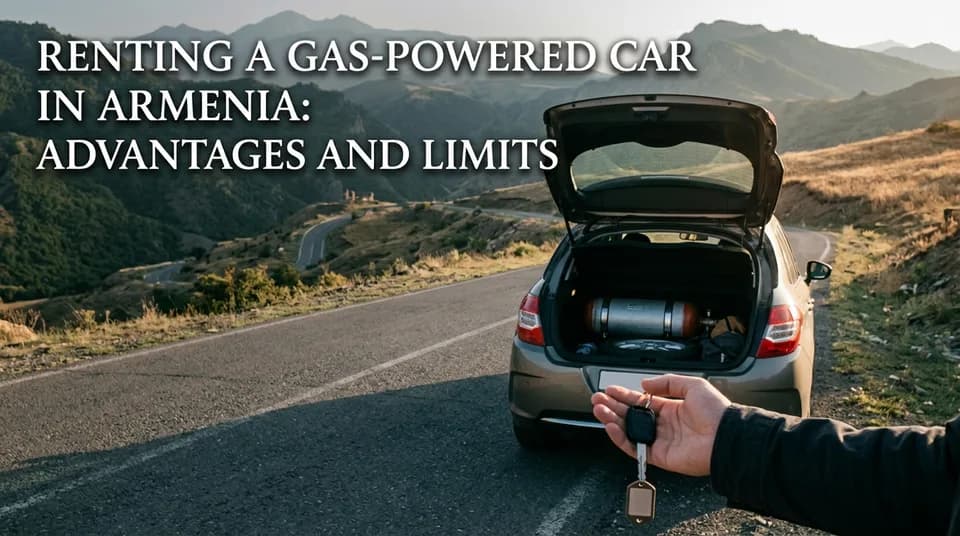
The gas cylinder usually takes up part of the trunk or the spare wheel well, so usable space is smaller than you'd expect. For two people and one suitcase, that's no problem. Five people, several suitcases and a stroller? That's a problem.
For a big family, a minivan may suit better, since the cylinder takes less out of its volume.
What to check at pickup
- Open the trunk and put in your actual luggage. See if it fits.
- Ask where the spare wheel and the jack (domkrat) are.
- Check that the cylinder is firmly secured. Nothing should move.
- Photograph the trunk, the cylinder and the fuel gauges.
- If you smell gas, don't take the car.
Gas stations in the regions: how far you can count on them
Outside Yerevan, don't take a gas station for granted. Check your route in advance. We don't quote numbers of stations or opening hours, because they change.
Practical rules:
- On the map, compare your route with gas stations, not only petrol stations.
- Ask the owner which stations they trust.
- Allow for queues and night hours. A station can be closed or eat your time.
- With a dual-fuel car, always keep a petrol reserve. Fill the cylinder before leaving Yerevan.
If the car runs on gas only, regional and remote routes get riskier.
How the engine behaves on climbs and mountain roads
On gas, the engine usually feels weaker uphill and under heavy load. Toward Sevan, on the Selim Pass or the Dilijan road, you notice it once passengers and luggage are on board. The difference depends on the engine and how the system is tuned.
On the phone, ask whether the owner recommends switching to petrol on the mountain stretch, and how it's done. That's the main strength of a dual-fuel car. For road rules and road conditions, check the Armenian Road Police site, roadpolice.am.
What to ask the owner before you call
A short list of questions answers nearly every surprise with a gas car.
- Is the car dual-fuel or gas only? How do you change mode?
- What size is the cylinder, where is it, and how much trunk space is left?
- How much petrol will be in the tank at pickup?
- Has the gas equipment passed the required inspection? Requirements can change, so check the current text on arlis.am.
- Ask to see the insurance policy. Don't assume it covers the gas equipment. Ask the insurer.
- Is there a mileage limit and a security deposit? JanCar doesn't receive or hold a deposit. If the owner asks for one, you arrange it directly.
- Is the car allowed into Georgia on gas? The filter doesn't replace a separate question.
Don't pay anything in advance until you've seen the car and its documents.
Who pays for the gas, and how
Usually the renter pays for fuel, but that's an owner's condition, not a law. Agree beforehand on the tank and cylinder level at return. The gas gauge may be inexact, so photograph both at pickup and at return. Put the terms in a message or a short written agreement.
Dual-fuel cars: switching modes and running out of gas
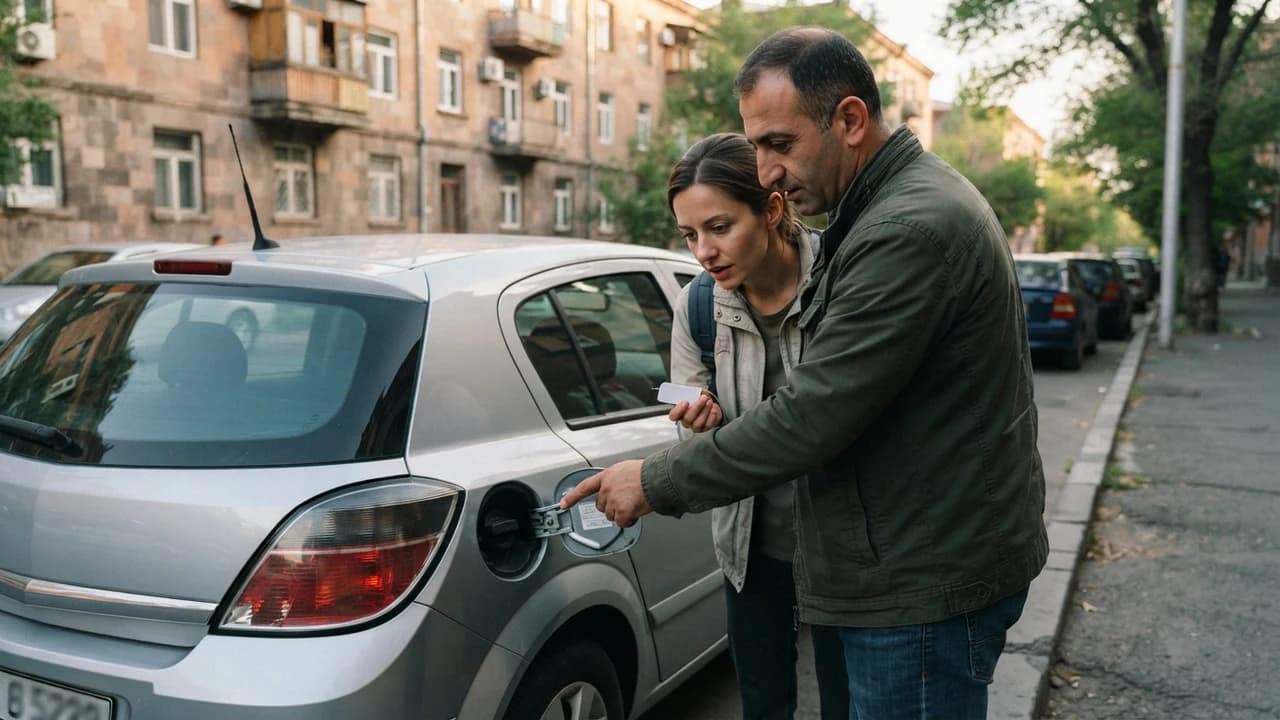
A dual-fuel engine usually starts on petrol and switches to gas by itself. At pickup, ask the owner to show you how the mode changes. Also ask what to do if the gas runs out mid-route, and who pays for the petrol used then. Settle all this with the owner by phone before you set off.
Pickup and return checklist
The same photos at pickup and return turn a dispute into a simple comparison. In addition to the list above, shoot in this order:
- The odometer (the distance counter).
- The petrol gauge.
- The gas gauge.
- The trunk, with the cylinder.
- The spare wheel.
- The registration certificate and the insurance policy. Check that the plate matches the car and the policy hasn't expired.
At return, repeat the same shots in the same order and compare with the owner on the spot.
Who a gas car suits, and who it doesn't
A gas car suits people who drive a lot in Yerevan, or on a long route over flat road, with little luggage. If you're heading through mountain sections, to remote regions or with a big family, a dual-fuel or petrol car is the better pick.
Wedding and event cars on JanCar always come with a driver, so for them the fuel type matters little to the renter. The owner decides what the car runs on and how it's filled.
Once you've decided, open the JanCar catalog (/cars), switch on the "Gas" filter, add your city and call the owner with the questions above.
Frequently asked questions
Is renting a gas car in Yerevan worth it?
If you'll drive a lot and carry little luggage, the math often favors gas. Compare that day's station prices, ask the owner for real consumption and check that the trunk is big enough.
Can I take a gas car to Georgia?
It depends on the owner's conditions. Check the "Trips to Georgia" filter in the catalog and ask separately about the gas equipment before you leave.
Who pays for gas in a rental?
Usually the renter pays for fuel, but the exact rule is the owner's. Agree the return level in writing and photograph the gauges.
Where to go next
- 15 Questions to Ask a Car Owner Before You Rent — add the gas questions to your general checklist.
- Petrol Stations in Armenia by Car: 4 Rental Steps — on filling practice and keeping a petrol reserve.
- Car Insurance When Renting in Armenia: What to Check — for the question of gas equipment and policy terms.
- Car Rental in the Regions: How to Find an Ad in Your City — for when your route goes beyond Yerevan.
- Renting a Seven-Seater or Minivan in Armenia for a Big Family — for when the cylinder takes too much trunk space.