
Rent a Car or Take Intercity Transport: What to Choose for Trips to Armenia's Regions
Marshrutka, a rental car without a driver, or a car with a driver: how to choose for Sevan, Dilijan, Gyumri or Syunik. Four criteria and a cost formula where you plug in the numbers.
11 min read
In this article
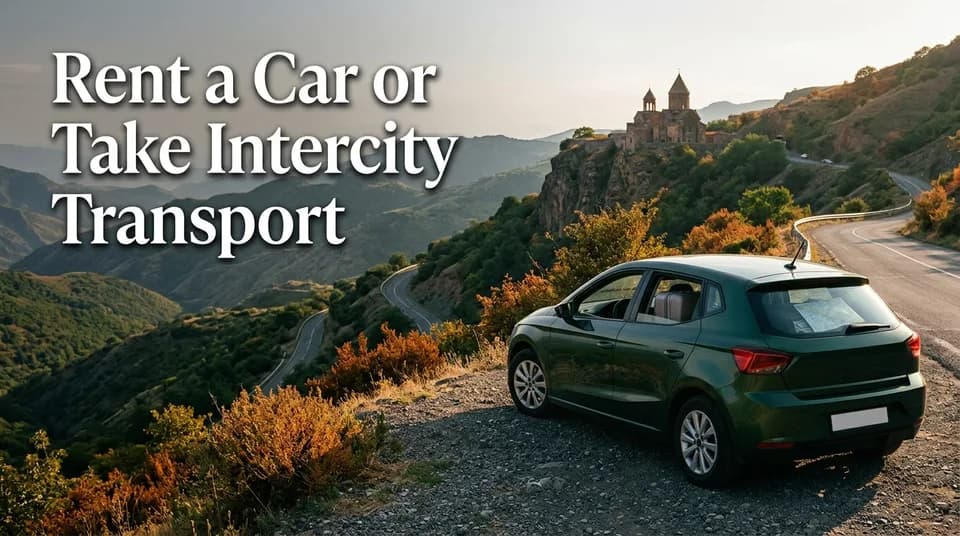
Rent a car or take intercity transport? It depends on how many people are going and what the plan is. A marshrutka (minibus) or intercity bus suits one traveller who just needs to get from one town to another. A rental car makes sense with several passengers, luggage, or a plan to visit monasteries and villages. A car with a driver is for when you don't want to drive, or can't.
The choice at a glance
Travelling alone, and the town itself is the goal? A bus or marshrutka is usually enough. Two or more people, stops at monasteries, heavy luggage? A car gives you more freedom. Here's a comparison on four criteria.
| Criterion | Marshrutka / bus | Car without a driver | Car with a driver |
|---|---|---|---|
| Schedule | You depend on departure times | You decide | Agreed with the driver |
| The last kilometre | Takes you to the town or village, then taxi or on foot | Straight to the place | Straight to the place |
| Luggage | Limited space | Most convenient | Convenient |
| Cost | A ticket per person | Daily price + fuel | Daily price with driver + fuel |
Schedule: whose clock you follow
On a bus or marshrutka, the route's timetable runs your day. Departures are usually a few hours apart, and the last return run can be very early, especially from smaller towns. A same-day round trip to Sevan or Dilijan is realistic, but for farther destinations time gets tight.
In a car, you decide when to leave, where to stop and when to come back. The catch: you have to respect the rental period and the mileage limit, if the owner has set one.
What to confirm at the station or with the driver
Timetables change, so check a current source, such as the Central Bus Station in Yerevan or the driver, not your memory of an old schedule. Ask four things:
- What time does it leave, and does the marshrutka wait until it's full?
- When is the last return run that day?
- How much is the ticket, and can you take luggage?
- Does it stop near your village or destination?
The last kilometre to the sights
Intercity transport usually gets you to a town or village, but not always to the monastery, waterfall or mountain spot. That "last kilometre" is the main headache for anyone heading to the regions without a car. Many monasteries sit a few kilometres off the main road, with no public transport going there.
Without a car, you cover that stretch by taxi or on foot, which costs time and needs a price agreed in advance. By car, the same spot is just another stop on your route. Seeing several villages and monasteries around Syunik or Gyumri in a single day by bus is close to impossible.
Luggage, children and comfort
A big suitcase, a child seat and gear all fit better in a car. On a bus or marshrutka space is limited, so ask the driver about luggage before you board. In a small marshrutka a large bag can take up a passenger's seat.
For families with children, there's another plus: in a car you can stop whenever you need a rest or a meal. Agree on a child seat with the owner beforehand. Not every ad offers one.
Total cost for 1, 2 and 4 passengers
For one passenger the bus is almost always cheaper, and as the group grows, each person's share of the car shrinks. Ticket costs rise in step with the number of passengers. The car's daily price doesn't. We don't quote specific figures: ticket prices and daily rates change, so use current ones.
What goes into the car's cost
A car's cost has three parts: the daily price, fuel and a possible security deposit. The owner states the daily price in the ad. You pay for fuel yourself, depending on route length and the car's consumption. The deposit is money some owners ask for, to be returned on conditions. It isn't a cost, but you need to have it on hand. JanCar doesn't receive or hold deposits; the two sides arrange it directly.
A simple example with your own numbers
Let T be the one-way ticket price, n the number of passengers, S the daily price and F the total fuel cost for the whole route.
- Bus: T × 2 × n (both directions), plus a taxi for the last kilometre.
- Car: S + F, and each person's share is (S + F) ÷ n.
- Car with a driver: the same formula, only with the with-driver daily price in place of S.
Plug in n = 1, 2 and 4 and compare the two results. For how to calculate fuel, see the related article below. If there's a mileage limit, check that your route doesn't exceed the daily cap.
Example: Yerevan–Dilijan–Sevan, 4 people, one day
For four people this route is often cheaper by car, but your numbers give the final answer. Take three figures: T (the one-way ticket for the route), S (the car's daily price) and F (fuel for the Yerevan–Dilijan–Sevan–Yerevan loop). If the bus trip has several legs, make T the sum of those tickets.
Work through it step by step:
- Total bus cost: T × 2 × n, plus a taxi for the Dilijan monasteries or the Sevan peninsula.
- Total car cost: S + F. It doesn't depend on the number of passengers.
- With n = 1, the car's per-person share is S + F, the whole amount. The bus, 2T plus a taxi, is usually cheaper.
- With n = 2, the car's share is (S + F) ÷ 2. Compare it with 2T plus your share of the taxi.
- With n = 4, the share is (S + F) ÷ 4. This is where the car often pulls ahead.
The break-even point, taxi not counted, is n > (S + F) ÷ (2T). A hypothetical: if (S + F) ÷ (2T) comes out at 2.5, then with three or more people the car is cheaper. Add the taxi to the bus side and its total grows, so the break-even point drops.
Example: Syunik, 2 people, 2 days with an overnight stay
On a two-day trip, extra costs join the same formula that a one-day trip doesn't have. Work them out in advance and ask the owner.
- Daily price: for two days. Ask whether the price is per day or total, and whether there's a minimum number of days.
- Fuel: F covers two days of driving, not one. Toward Syunik it's bigger than for a Sevan loop.
- Mileage limit: two days of driving, including detours to monasteries, mustn't exceed the limit. Ask whether the limit is per day or total.
- The driver's overnight stay: with a driver, agree who pays for his accommodation and meals.
- Return: if you pick the car up in Yerevan, ask whether you can return it somewhere else, and at what time.
What to agree on for the with-driver option
With a driver, everything depends on what you agreed before setting off. You settle these points directly with the owner, in writing or at least confirmed by message.
- Start and end of the day, with exact times.
- The driver's meals and overnight stay: on your bill, or included in the price?
- Fuel: included in the daily price, or paid separately?
- Waiting time: what happens if you stay long at a monastery or stop for photos.
- Number of stops and extra destinations if the plan changes.
A car with a driver: the middle option
A car with a driver sits between a marshrutka and a self-drive rental. The driver is yours for the whole day, but you don't have to drive. It suits people without a driving licence, people who are tired, or anyone who'd rather not tackle a tricky mountain road. Stops at the sights are agreed beforehand.
On JanCar a car can be offered without a driver, with a driver or both, each with its own daily price. When you call, state the route, the number of stops, the hours and whether fuel is in the price. Renting without a driver requires a driving licence. Confirm the terms with the owner, and check the general rules on the Road Police website.
A low body or higher ground clearance?
A sedan is fine for paved highways, but some roads to monasteries can be gravel or rocky. Pick the body type by route, using the catalog filter. If you're planning village or mountain roads, look at the higher-clearance options.
We can't tell you the condition of a specific road. It changes with the weather. Ask locals or the owner whether your chosen car will make it to that monastery.
Winter and late autumn on mountain passes
In late autumn and winter, mountain passes, such as toward Selim or Vardenyats, can become difficult or close. Before you leave, check road and weather conditions from a current official source. We don't give closing dates: they vary from year to year.
Ask the owner about winter tyres and whether he allows your route. If the answer is vague, choose the with-driver option or shorten the route.
How to find a car on JanCar and agree terms
JanCar is a classifieds board. It doesn't book cars and doesn't take money. The process is simple:
- Open the catalog and choose the city, the rental type (without a driver or with a driver) and the filters you need: body type, seats, no deposit, unlimited mileage.
- Sign in to see the owner's phone number.
- Call and confirm the daily price, deposit, mileage limit, minimum days, driver's age and licence, and the pickup and return place.
- Before you pay, see the car and its documents, photograph its condition, note the fuel level and put the agreement in writing.
There's no online booking, chat or payment through JanCar: you agree everything directly with the owner. The "Verified" badge means the car's registration certificate was checked at moderation. It is not a technical inspection or a guarantee. Don't prepay before you've seen the car and its documents.
Checklist before you call
Prepare answers to seven questions so you can ask the owner once:
- route length in kilometres, round trip, including detours to monasteries,
- the daily mileage limit and what happens if you exceed it,
- the minimum number of days,
- the deposit amount and return conditions: when and in which cases it's returned,
- fuel policy: what level it's handed over at and what level it's taken back at,
- whether regional and mountain roads are allowed,
- the pickup and return place and time.
Checklist when you receive the car
Do everything when you pick the car up, before paying, not after.
- See the car and its documents: the registration certificate and the insurance. Ask what the insurance covers, and assume nothing.
- Walk around the car and photograph every scratch and dent.
- Check the spare wheel, the jack and the tools.
- Note the fuel level and the odometer reading, with a photo.
- Both sides sign a short written agreement or receipt.
JanCar's "Verified" badge doesn't replace this check. It only shows that the registration certificate was checked at moderation.
What to do if the plan changes
Agree changes in advance, not on the road. Call the owner as soon as you know you're running late, the route or return place is changing, or you want to extend the rental. Confirm what changes in the price and get it confirmed, at least by message.
JanCar has no chat or booking system, so everything happens by phone and in person. Save the owner's number in your phone and check that he picks up before you set off.
Frequently asked questions
Is a marshrutka or a rental car cheaper for several people heading to the regions?
For one passenger the marshrutka is usually cheaper. With two or four people, each person's share of the car drops. Compare T × 2 × n for the bus with (S + F) ÷ n for the car, using current prices.
Can I take a car with a driver for a trip to the regions?
Yes. Several JanCar ads offer the car with a driver, at a separate daily price. You agree the route, hours and stops directly with the owner by phone.
How do I get to a monastery or waterfall without a car?
Intercity transport takes you to the nearest town or village, and you cover the last stretch by taxi or on foot. Agree the taxi price and waiting time beforehand.
Where to go next
- Fuel calculation for a route in Armenia: formula and example — work out the car's fuel cost for your route.
- Yerevan to Tbilisi one way: rental car or with a driver? — the same with-driver or self-drive choice, on an international route.
- Car rental documents checklist in Armenia — which documents you'll need when agreeing terms with the owner.
- Renting a car in Armenia: a step-by-step plan — the full steps for those who've decided to rent.
- Google Maps or Yandex Maps: choosing navigation for driving in Armenia — picking navigation for a drive to the regions.