
Parking at Armenia’s Attractions: A Practical Guide
At Armenia’s attractions, choose a designated car park and check the signs and restrictions. If anything is unclear, find another place where parking is permitted.
9 min read
In this article
At Armenia’s attractions, choose a designated car park and check the signs and restrictions. If anything is unclear, find another place where parking is permitted.
When parking at Armenia’s attractions, choose a designated car park and check the sign permitting parking, the markings and any restrictions in place. Don’t block an entrance, a turning area or a pedestrian route. If the car park is full or permission to park is unclear, find another permitted space and continue on foot along a safe route.
Make three separate checks: permission to park, physical safety and rental terms. They aren’t interchangeable: the owner’s agreement doesn’t grant permission to park, and a parking sign doesn’t guarantee the car’s security.
What to check before visiting an attraction
Before setting off, confirm the car park entrance, opening hours, possible restrictions, whether there’s a fee and the walking route from the car park to the attraction. Start with the attraction’s official operator or the person responsible for the designated car park.
Don’t just ask, “Is there parking?” Ask, “Which entrance should I drive to?” and “How do I reach the attraction’s entrance after parking?” A map pin may mark the monument rather than the vehicle entrance. Save the confirmed location before you leave.
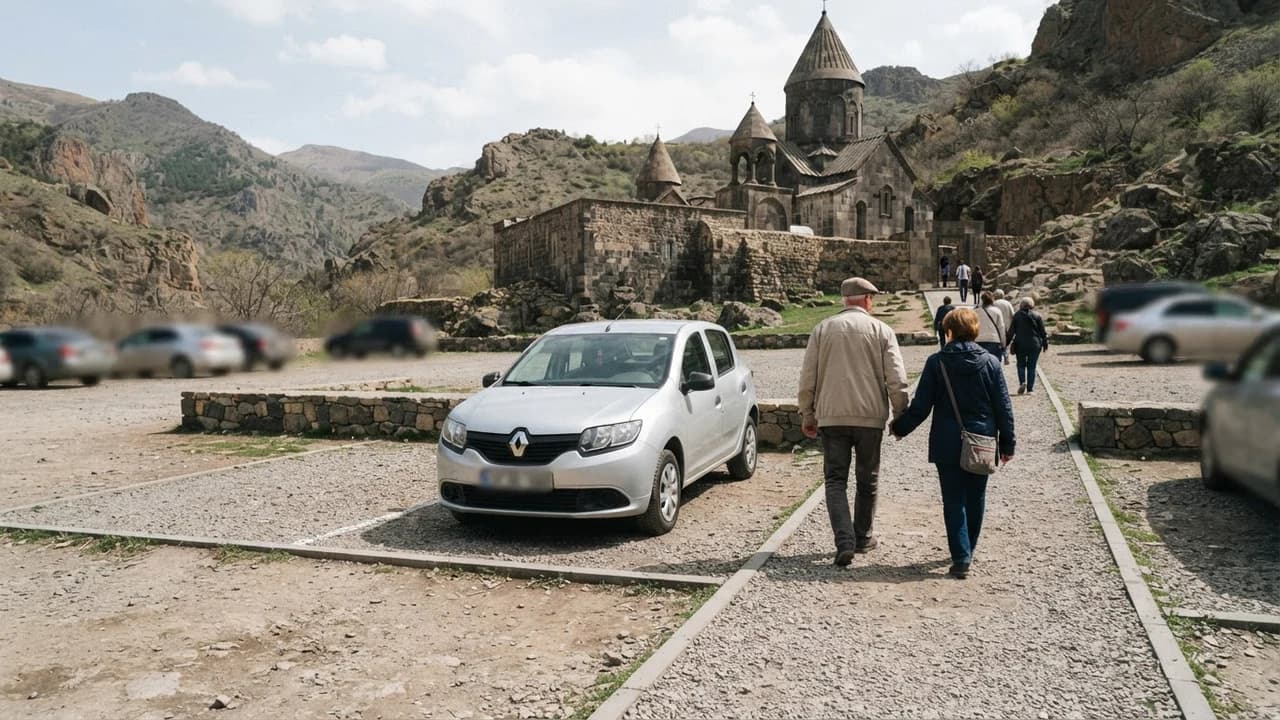
Garni, Geghard and Sevan are planning examples here, not a list of verified car parks. For Sevan, you also need to choose the specific place you’re visiting: the general place name isn’t enough to identify an entrance. This guide does not confirm current parking fees, opening hours or available spaces at these destinations.
If you’re travelling with family, ask ahead about the walking surface, steps and any roads you’ll need to cross. Distance from the entrance isn’t enough to judge suitability. A short route through moving traffic may be awkward with a child or pushchair.
For road restrictions, check relevant official announcements from Armenia’s Ministry of Internal Affairs and the Police. Compare the announcement’s date and the road section it names with your route. Don’t treat an old update about weather or access as confirmation of conditions on the day.
Current official announcements have not been checked for this guide, so we don’t provide a verification date or state which restrictions are in force. Study the map and make any necessary calls before setting off or after stopping somewhere safe—not while driving.
How to tell where you can park when you arrive
Check parking signs and road markings first, then assess the car park’s conditions and the safety of your chosen space. Read any supplementary plates and other restrictions alongside the parking sign.
Don’t rely on the fact that other cars are already parked there. Someone’s verbal invitation, a request for payment or an orderly-looking parking area isn’t proof that parking is permitted. If a sign is obscured or you can’t tell where it applies, clarify the situation without leaving the car in the disputed space.
The primary source for legal questions is Armenia’s current road traffic rules, available through ARLIS, the Armenian Legal Information System. The relevant provisions of the current legislation have not been checked for this guide, so we don’t list statutory distances, fines or exceptions. The guidance below is a practical safety approach, not confirmation of legal permission to park.
I recommend assessing each possible space using this decision table. If even one answer is no or unclear, take the corresponding next step rather than walking away from the car.
Check
What to assess
If the answer is no or unclear
Is parking permitted?
Signs, markings and restrictions in place.
Clarify the rules or choose another permitted space.
Is the space physically safe and accessible?
The surface, slope, visibility and clear access in and out.
Choose a different space, and don’t attempt an unsafe approach.
Does it meet the rental terms?
The agreed restrictions on using the car.
Check with the owner or don’t enter that area.
Which spaces to avoid and which risks to check
Avoid any space where the car would block an entrance, a turning area or a pedestrian route, even for a short visit. Don’t drive into a pedestrian area or somewhere not intended for parking just to get closer to the attraction.
Before entering a space, assess soft ground, unstable edges, deep potholes and slopes. Think about getting out, too: will you be able to see approaching vehicles and leave without a dangerous reversing manoeuvre? An empty space isn’t necessarily a suitable one.
Choose a position where passengers can get out on the side away from moving traffic. Before children get out, an adult should check the surroundings and accompany them to a safe area. Before opening a door, look for passing cars, bicycles and pedestrians.
At a paid car park, first confirm the published rate, how the charge is calculated, the payment method and who is responsible for the parking area. Ask whether you can get a document confirming payment. If the terms aren’t clearly explained, don’t assume the final amount has been agreed.
Ask separately whether security is provided, who provides it and on what terms. A parking fee doesn’t automatically include a promise to guard the car, protect it from theft or compensate you for damage. A camera alone doesn’t tell you who accepts responsibility for what.
What to do if the car park is full or the terms are unclear
If the car park is full, choose another permitted space with a safe walking route. If none is available, change the order of your visits. Don’t wait where you’ll block an entrance or traffic, and don’t drive onto the pavement to make room.
Ask the person responsible about another designated car park, then assess its entrance and conditions yourself. Check whether the walking route involves walking along the carriageway, passing a bend with poor visibility or returning through an unlit area. If the approach isn’t safe, don’t use that alternative.
If you change the order of your visits, review your return time too. Waiting for a space could mean returning after dark. Leave some spare time, but don’t try to make up a delay by driving faster or leaving the car somewhere not intended for parking.
What to confirm with the owner when renting a car
Check parking restrictions and what to do if the rental car is damaged through the listing, the owner, the rental agreement and the insurance policy. These are separate terms; they don’t determine whether parking is permitted under road traffic rules.
JanCar is a peer-to-peer marketplace connecting renters with independent car owners in Armenia, not a rental company with its own fleet. Check the vehicle listing and confirm with the owner the price, availability for your dates, driver eligibility, mileage allowance, fuel terms, insurance, and pickup and return locations. Make sure what you’ve agreed matches the contract.
A security deposit is an amount the owner requires as security, with clear terms for its use and return. JanCar does not receive, block or hold a security deposit. The renter and owner arrange the transfer and return of any fixed deposit stated in the listing directly with each other.
Before setting off, ask to see the insurance policy and clarify any cover for damage or theft while parked. Ask about exclusions and the excess—the portion you would have to pay yourself. Having a policy doesn’t by itself confirm that a particular incident will be covered.
Also confirm the procedure for reporting an insurance incident: whom to notify, what information to provide and what deadlines the terms specify. If you notice damage, contact the owner and the relevant insurer from a safe place. Don’t arrange repairs yourself before clarifying the required procedure.
To document the vehicle handover, you can choose to take photos of its condition and record the fuel level and existing damage. A digital handover record signed by both parties can clarify the condition each accepted. Photos don’t guarantee an insurance payout or a dispute-free rental.
Does paid parking mean the car park is guarded?
No. A fee alone doesn’t confirm that security is provided. Ask the person responsible separately about guarding arrangements, terms and liability. Proof of payment isn’t, by itself, a guarantee of compensation for damage.
Does insurance cover damage to a parked rental car?
Cover depends on the applicable policy, the circumstances of the incident and any exclusions. Check the policy and confirm with the insurer and owner rather than relying only on an “insurance” label in the listing.
A step-by-step checklist before parking and leaving the car
Only leave the car after checking that parking is permitted, the location is safe and the space meets the rental terms. Follow the same sequence for a short stop, without rushing.
- Read the signs, supplementary plates and markings. Don’t treat an unclear answer as permission.
- Make sure you aren’t blocking an entrance, a turning area, a pedestrian route or another car’s exit.
- Assess the firmness of the ground, the slope, visibility and whether you’ll be able to drive out later.
- Let passengers out on the safe side, and accompany children to an area away from moving traffic.
- If needed, photograph the car’s condition, close the windows, lock the doors and leave no valuables in sight.
- Remember the route back, the car park entrance and its confirmed closing time, if one applies.
- If any condition is unclear, don’t park there: clarify it, choose another permitted space or change the order of your visits.
Related guides
Find more guidance in these checked, related guides.
This is general information. JanCar does not receive or hold a vehicle deposit. Check price, deposit, insurance and every other term on the listing and directly with the owner.
More JanCar guides
Continue with these closely related practical guides.
Where to go next
- Parking in Dilijan's Centre by Car: A Practical Guide
- Driving to a Festival in Armenia: Parking, Timing and the Drive Home
- Driving to Festivals in Armenia: Parking, Timing and the Drive Home
- Foreign Driving Licence in Armenia: A Practical Guide
Sources
- JanCar — how it works
jancar.am · official source
- JanCar car catalogue
jancar.am · official source