
Ijevan to Makaravank by Car: Visit Checklist
Start the Ijevan–Makaravank drive from Ijevan, and confirm the last stretch of road before you commit to it. Plan your fuel and your return so you're back before dark.
10 min read
In this article
Start the Ijevan–Makaravank drive from Ijevan, and confirm the last stretch of road before you commit to it. Plan your fuel and your return so you're back before dark.
Plan the Ijevan–Makaravank trip as a loop that begins and ends in Ijevan, with a return before dark — and check the condition of the final stretch to the monastery, plus entry and parking, in advance. Before you leave, check the weather, your fuel, your offline map and the terms attached to the car you've rented. If conditions are unclear or poor, postpone the monastery section.
The route in outline: Ijevan, the Achajur road, Makaravank
This route starts and ends in Ijevan, and the approach to Makaravank needs to be checked separately along the Achajur road. When you plan this trip in Tavush Province, use a current map to find the main road, the turn toward the monastery and the final approach. Compare the destination pin on the map against the monastery's name and its actual location.
A report about the main road does not confirm that the last stretch to the monastery is passable. Find out separately whether the information covers the whole approach or only the road as far as the turn. If the answer is vague, ask for the specific section and the date the information was issued.
We're not giving a verified distance or drive time here. A map estimate is the starting point for your own calculation, not a promise of arrival. Add time for picking up the car, stops, walking from the parking spot and an unhurried return. Treat getting from Yerevan to Ijevan and back as a separate calculation — don't assume this is a guaranteed day trip from Yerevan.
What to check before you leave: road, weather, entry and parking
Deciding to go requires separate answers on the road, the weather and access to the site. No current official publications were verified for this article, so the source names below are directions for your own checking, not confirmation that the road is open. We don't invent a date for a check that wasn't made.
Next to each answer, note the publication date, the day you checked it in DD.MM.YYYY format and, where possible, the time. When you speak to someone responsible, keep their name and role. An old photo or an undated comment isn't enough to base a same-day decision on.
- Road and restrictions. On the official armroad.am source of the Road Department fund, look for the notice covering your specific section. Record the publication and check dates. If there's no information about the final approach, don't treat it as confirmed.
- Weather and precipitation. Check the Tavush forecast and warnings on armhydromet.am, the source of the Hydrometeorology and Monitoring Center CJSC. Note the forecast's validity period and the day you checked. If poor visibility is likely, reconsider the monastery visit.
- Entry and possible fees. Use tavush.mtad.am, the source of the Tavush Governor's Office, to look for a relevant notice or the contact details of the responsible body. We have no official confirmation of entry conditions or fees here. Check with whoever is responsible for the site, first confirming their identity and their connection to it.
- Parking and the walk. Ask the same responsible person where you can leave the car, what surface to expect and how far you'll have to walk. Record the day you checked. If there's no answer, don't treat parking — or driving right up to the entrance — as confirmed.
If you're travelling with children or with passengers who have difficulty walking, also check the steps, the gradient and places to rest. Present what a responsible person tells you as a direct enquiry, not an official publication. Don't try to open your own route on the spot because entry or parking is unclear.
The car you rent: the owner's terms and JanCar's role
For Makaravank, choose a car on the basis of confirmed road conditions and the owner's consent, not ground clearance alone. JanCar is a peer-to-peer car-rental marketplace operating in Armenia. The cars belong to independent owners, not to the platform.
Check the car, the price, date availability, driver eligibility, the mileage limit and how extra mileage is calculated — on the listing, with the owner and in the contract. Agree the pickup and return place and time in writing. Ask whether the route you have in mind is allowed and what road restrictions apply.
Ask for a clear answer on the condition of the tyres and brakes, the fuel type, and whether there's a spare wheel or a repair kit. At pickup, familiarise yourself with the lights, the wipers and the demisting controls. If you have doubts about the car's mechanical condition, don't use a mountain approach to test it.
Establish the scope of the insurance from the contract or the certificate. Ask about permitted drivers, road exclusions, your contribution if there's damage, and what to do in the event of an accident. Keep the agreed emergency contact. A note saying "insured" on a listing doesn't yet explain all the terms.
A deposit is a security sum the owner asks for, if such a term exists. JanCar does not receive, block or hold a deposit. When a listing states a fixed deposit, the renter and the owner arrange the transfer and its return directly between themselves. Don't assume the platform protects that money.
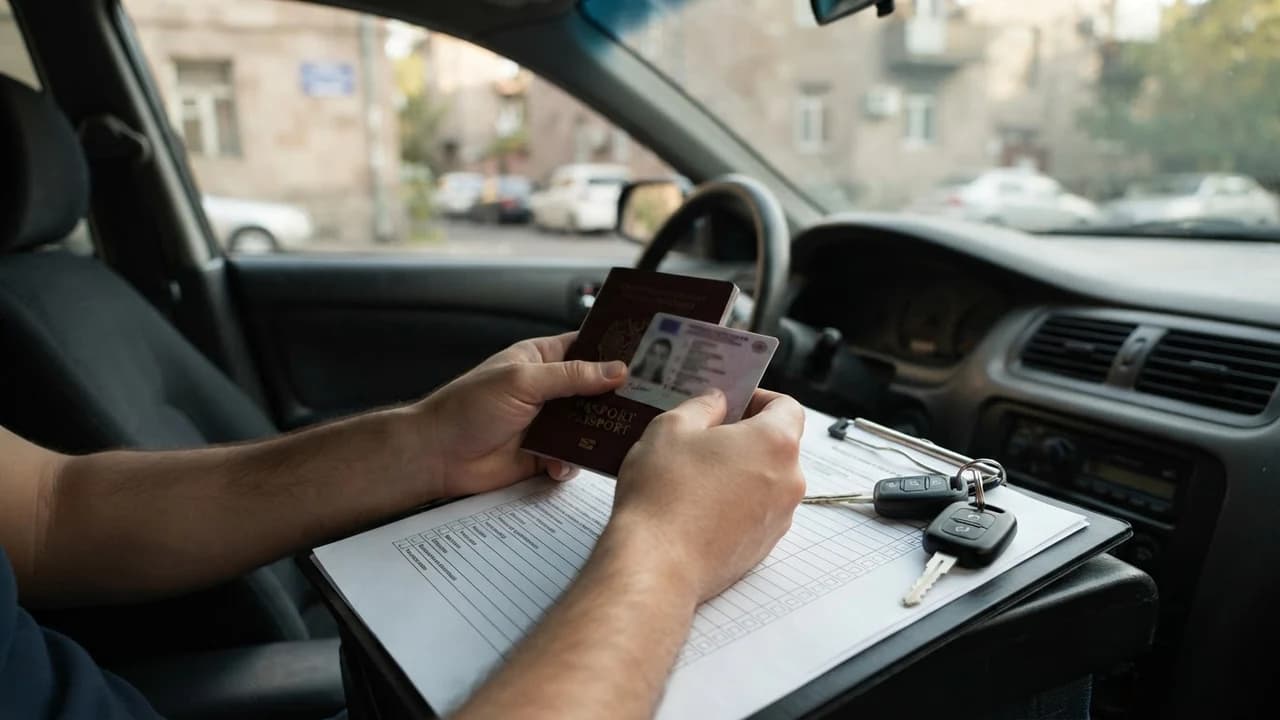
In your document checklist, include the driving licence, ID, the rental agreement, the vehicle registration certificate and the insurance policy or certificate. Confirm what to submit, what to carry on the road and who is named as the driver. This is a preparation list, not a verified complete list of legally required documents.
An owner's requirement, a legal requirement and a JanCar rule are three different things. No current primary source on the legal document requirements was verified here. Especially with a foreign licence, don't stop at the owner's agreement — check legal applicability with a competent state source as well.
As a voluntary measure, photograph the car, record the fuel gauge and note any existing damage. A handover act signed by both sides, including a digital version, helps record the condition as accepted. This is advice, not a description of a JanCar feature. Agree the return cleanliness terms too.
Fuel and connectivity: prepare while still in Ijevan
Sort out fuel and a backup for connectivity in Ijevan, before the approach to the monastery. Choose a working filling station in advance and check its hours and whether it has the fuel you need. This article doesn't guarantee any station's hours or continuous coverage from any mobile operator.
Work out the whole round trip by multiplying the kilometres by the specific car's consumption and dividing by a hundred. Discuss extra reserve with the owner for climbs and any detour. If the consumption figure is only approximate, don't build the plan around returning on a nearly empty tank.
Download an offline map and check that it opens without a signal. Charge your phone, take a suitable charger and keep the owner's and emergency contacts stored separately. A map is not proof that a road is open. Tell someone close to you your route and your expected return time.
The final approach: mountain road, parking and the main risks
Continue the final approach only if visibility, the road condition and the car's capabilities match your level of preparation. What follows is a way of assessing the situation, not a list of confirmed obstacles on the ground. Don't follow an unknown shortcut suggested by a map.
If you see unassessed potholes, mud, ice or a narrowing, pick a safe place to stop first. Don't stop on a bend with poor visibility, and don't attempt a turn in a dangerous spot. A high car or a four-wheel drive doesn't guarantee passability, braking or a safe return.
Park only in a permitted and safe place, without blocking an entrance, a passage or other cars' exit. Before leaving the car, assess how you'll get out again. Don't set up a photo stop on a dangerous stretch of road, and don't extend it at the expense of your return time.
When to turn back: calculating a return before dark, and the alternative
Work out your latest departure time from Makaravank so that you reach Ijevan well before sunset. Check the sunset for the chosen day and place in an astronomical calendar that names its source. Record the source and the day you checked — no specific time is confirmed here.
Latest departure = sunset time − realistic return duration − extra time. The extra time is your own planning choice, not a safety guarantee. Build into it reaching the car, stops and possible slowdowns. Cloud cover or a forested section can force you to turn back earlier.
Criterion
Continue if
Don't continue if
Road
The condition of the final section is confirmed and its use is agreed.
Passability is unconfirmed or looks doubtful on the ground.
Weather and visibility
You can see the road and obstacles in good time.
Visibility isn't sufficient or conditions are worsening.
Fuel
Your return and reserve calculation is sufficient.
The reserve is doubtful or depends on an unconfirmed filling station.
Daylight
The return fits within your calculated reserve.
The deadline has passed or time is short.
One negative answer is enough reason to rethink the plan in a safe place. If the road is unclear, the weather is bad or time is short, don't go up to the monastery. Limit the trip to Ijevan itself only if getting there and your return are also safe.
Final checklist before you leave
Confirm you're ready to go with these points, not just by taking the car keys. Flag anything unresolved openly, rather than closing it with a "we'll see when we get there" assumption.
- Road and weather reports are checked, with sources and dates recorded.
- Entry, possible fees, parking and the walking section are confirmed, or the uncertainty is noted.
- The owner's terms, documents, insurance and emergency contact are clear.
- Fuel is sufficient with a return reserve, and the phone and offline map are ready.
- A return deadline is set, and limiting the trip to Ijevan is an acceptable option.
The last step is to re-check the official notices on the day of travel and confirm the owner's terms. If you haven't chosen a car yet, compare listings in the JanCar car catalogue against these criteria, checking each car's suitability separately.
Related search paths
Continue the topic with these verified related guides.
This is general information. JanCar does not receive or hold a vehicle deposit. Check price, deposit, insurance and every other term on the listing and directly with the owner.
More JanCar guides
Continue with these closely related practical guides.
Sources
- JanCar — how it works
jancar.am · official source
- JanCar car catalogue
jancar.am · official source