
Planning a Wedding Car Convoy: How Many Cars, the Route and the Timing
The number of cars, the order of stops, a time buffer and one coordinator. That's what keeps a wedding convoy from scattering in city traffic.
11 min read
In this article
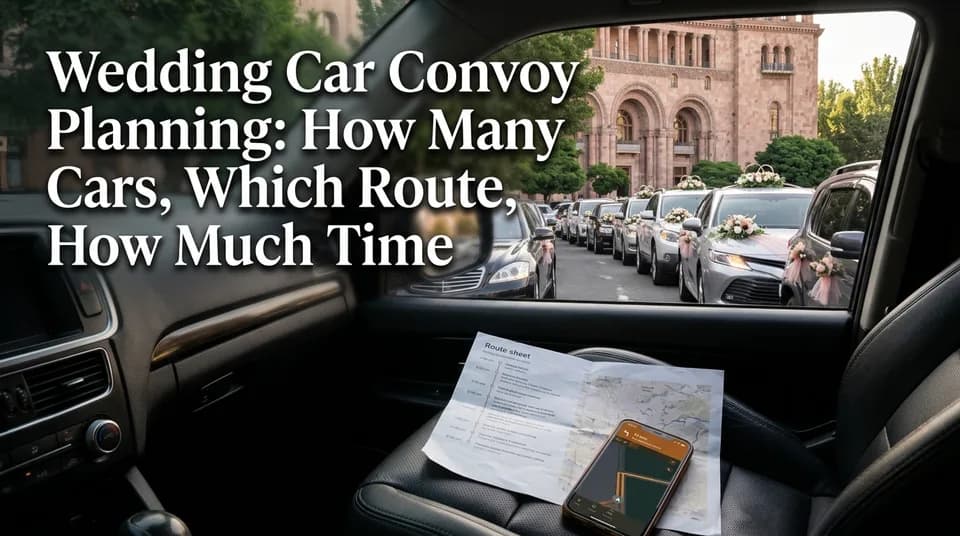
Planning a wedding convoy comes down to three things. How many cars you need (the main car, the family cars, and guest cars only if guests can't get there on their own). The order of stops, written as one route. And a time buffer added to every leg. One coordinator who holds all the drivers' phone numbers keeps the convoy together.
Below is the car side only. The venue, the budget and the invitations are outside this article.
How many cars a wedding needs
At minimum you need one main wedding car with a driver. The rest is decided group by group, not by a general rule. There's no official number, and every family counts from its own list.
The main car and the family cars
The main car belongs to the bride and groom. After that, count who must travel with them (parents, witnesses, close relatives) and how many people fit in one car. The photographer usually drives their own car, so they can get ahead and be waiting at the next stop.
| Group | Example count | Note |
|---|---|---|
| Bride and groom | 1 main car | with a driver |
| Parents and witnesses | 1–2 cars | by seats |
| Close relatives | 1–3 cars | by the list |
| Photographer | 1 car | usually their own |
| Guests | 0 or more | only if needed |
The numbers in the table are examples, not a norm.
Two worked examples: counting by seats
Start from the list and divide by the number of seats. The examples below are illustrative: they assume an ordinary sedan that seats 4 people besides the driver. Ask the owner how many the actual car takes.
A small family convoy. The list has the bride and groom, 4 parents and 2 witnesses. The main car carries only the couple, because the dress and bouquet take up most of the back seat. The 4 parents fill the second car, the 2 witnesses go in the third. That's 3 cars, plus the photographer's car and one spare.
A large family. The list has the bride and groom, 4 parents, 2 witnesses and 12 close relatives, 18 people in all. Divide 18 by 4 and you get 4.5, so 5 cars, plus the main car makes 6. If the relatives include small children or there's a lot of luggage (a second dress, boxes), add one more car. Your sheet will have 6 core cars, the photographer and the spare: 8 rows in total.
Guest cars: when you need them and when you don't
Separate cars for guests are only needed when they can't reach the venue on their own, for example at a wedding outside the city or with elderly guests. If the venue is in town and guests have their own cars, pulling them into the convoy just adds confusion. It's simpler to give them the address and the time.
Who drives: a car with a driver or a relative
For the main car, a driver is the calmer option. His whole day is the convoy, while a relative wants to celebrate too. A relative's car works fine in a secondary role, provided they stay sober, know the route and keep their phone on.
The order of stops in one route
The route has to be written down, in one fixed order, with a time and an address for every stop. A verbal "we'll swing by the bride's house and then see" starts falling apart in the first traffic jam.
A typical order: home, registry or church, photos, venue
Most families' day looks like this, though you can change it:
- The bride's home: meeting and departure.
- The groom's home, if it's on the route.
- The civil registry office (ՔԿԱԳ, the civil status registration office) or the church.
- One or two photo locations.
- The venue.
The registration or church time is usually fixed, so you calculate the whole day backwards from it. The first car in the convoy can be the main car or an escort car that knows the route well. What matters is that the order is written down and each driver knows whose car they follow.
Whether cars can park near the registry office or church, and for how long, depends on the specific place. Call them ahead and ask where several cars can stand and until when. Don't assume numbers or rules. Write the answer you get on the sheet.
A time buffer for city traffic
Add the time buffer to each leg separately, not once at the end of the day. A delay at one stop gets passed on and grows, while a separate buffer on each leg absorbs it.
[Yerevan traffic](/en/blog/yerevan-traffic-route-planning-time-buffer-guide) is usually heavier on Fridays and Saturdays after midday, so make the buffer bigger for those hours. There's no official figure, and the size is your call. It helps to drive the route once, on the same day of the week and at the same hour, before the wedding, and see where traffic stops.
A convoy moves at the speed of its slowest car. Count that time too.
A worked example
The numbers are illustrative and only show the method. Measure the real driving time on your own route. Say registration at the registry office is at 14:00 and the reception at the venue is at 17:30. You count backwards from the registry office.
- Bride's home → registry office. Leave at 12:50, 25 minutes on the road, 15 minutes buffer. You arrive at 13:30, half an hour before registration.
- Registry office → photo session. Leave at 14:45, 20 minutes on the road, 10 minutes buffer. The photo window is 15:15–16:15.
- Photo session → venue. Leave at 16:15, 30 minutes on the road, 15 minutes buffer. You arrive at 17:00, half an hour before the reception.
Without the buffer on the first leg, a 15-minute delay would carry over to the next two stops and shorten the photo window. With its own buffer, it stays on the first leg.
Photo time inside the convoy
Give the photo session a clear time window, at one or two locations, agreed with the photographer in advance. That slot is a stop on the list like any other, not "as long as it takes".
Write one rule down beforehand: when the window ends, the convoy moves on to the next point, even if the photographer wants one more shot. That rule spares you an awkward conversation in the moment. For the locations, check in advance whether several cars can park there, so the convoy doesn't block the road.
The coordinator and the drivers' phone numbers
The coordinator is one person who holds the full convoy sheet and calls each driver. It shouldn't be the bride or the groom, because for them the day is about something else.
For each car, the sheet lists:
- the driver's name,
- the make and colour of the car,
- the licence plate number,
- the phone number,
- the names of the passengers,
- the route, with times and addresses.
Send the sheet to all the drivers the day before, as a message, so everyone has the drivers' phone numbers and the route on their own phone.
A sample sheet
The route (stops, times, addresses) goes at the top of the sheet, once for everyone, and each car gets one row. The names, plates and numbers here are placeholders.
| № | Driver | Make, colour | Plate | Phone | Passengers | Follows |
|---|---|---|---|---|---|---|
| 1 | Aram | white sedan | 00 AA 000 | 055 00 00 00 | bride, groom | leads, main car |
| 2 | Gagik | dark blue sedan | 00 BB 000 | 077 00 00 00 | 4 parents | car № 1 |
The last column matters most. If every driver knows whose car they follow, the convoy regroups even after a small jam.
Think through the "what if" in advance. If a driver is late, the coordinator calls, and the rest of the convoy carries on without waiting. If a driver gets lost, you send the address of the next stop and meet there. If a car breaks down, the passengers move into the spare car agreed beforehand.
The spare car
A spare car is real help only under three conditions: the driver is reachable by phone all day, knows the route, and can get to any point. If one of those is missing, it isn't a spare car, it's just an extra car.
Agree in advance where it waits. A good spot is the middle of the route or near the next stop, so it doesn't block the road and can arrive quickly. On the sheet the spare gets its own row with the same columns, and in the "follows" column you write "stays put, waits for a call". The coordinator and the spare driver should have each other's numbers before any other driver does.
Traffic rules while driving in convoy
A wedding convoy has no special rights. It's a group of cars driving under the ordinary traffic rules, and each driver is responsible for their own car.
The practical principles are simple. Keep a safe distance, match your speed to the slowest car, don't try to "squeeze" the whole convoy through a red light, and don't block intersections. For the rule on using hazard lights, check the law rather than assuming.
Read the current text in the arlis.am legal database: the Armenian law "On Road Traffic", paying attention to the date of the latest amendments. For public information, see the Road Police website as well. We don't give fine amounts here, because they change.
Edge cases
The plan works well on an ordinary day, but three situations are worth planning for.
- A narrow yard or street. If several cars won't fit near the bride's home, set the meeting point at the nearest wide spot, and bring only the main car up to the house to pick up the bride. Tell the other drivers on the sheet.
- Bad weather. In rain or snow the road gets longer and speeds drop. That day, increase the buffer on every leg, and if one of the photo locations is outdoors, you can drop it.
- A venue outside the city, or a mountain road. Work out the buffer for that stretch separately from the city legs, because a slow car stretches the convoy more here. Drive the road once beforehand and note where you can safely pull over and wait for stragglers.
How to find a car and driver on JanCar
JanCar is a classifieds board where you can find cars with a driver, and you call the owner directly. The site doesn't book cars, take money or hold a deposit.
Wedding ads always come with a driver. You pick the city in the filter, browse the ads, sign in, see the owner's phone number and call. The "Verified" badge means JanCar checked the car's registration certificate at moderation, but it is neither an inspection nor a guarantee.
In short: in the catalog you choose the city and the with-driver option, open an ad, sign in, call the owner and agree directly on the date, the hours, the route and the deposit, if the ad states one.
On the call, settle these with the owner: the time, the route, the waiting time, the decorations and the price. Confirm the terms in writing. Don't send any prepayment until you've seen the car and its documents. If the owner asks for a deposit, that's a direct arrangement between the two of you.
The checklist for the day before
The day-before checklist is limited to five items, and all of them should be ticked off by evening.
- The route is written down: stops, times, addresses.
- Plate numbers and phone numbers have gone out to all drivers.
- The fuel tank is full, or the driver has confirmed it is.
- The decorations are ready, and the owner agrees with the way they'll be attached.
- The spare car and the coordinator's "what if" plan are agreed.
The checklist for the morning of the day
The morning check takes a few calls and prevents a lot of delays.
- The coordinator calls each driver and confirms the departure time and the meeting point.
- The cars are clean and the fuel level has been checked again.
- The phones of all the drivers and the coordinator are charged.
- It's clear where each car stands outside the bride's home, and the road is free.
Frequently asked questions
How many cars does a wedding need?
There's no official norm. The main wedding car is a must, and the rest is decided by group: parents, witnesses, close relatives, the photographer. Guest cars are needed only if guests can't get there on their own.
Why do you need a coordinator?
The coordinator holds every driver's name, plate number and phone number, plus the route sheet. If a car is late or gets lost, one call sorts it out, and the bride and groom aren't distracted.
Does a wedding convoy have special rights on the road?
No. A convoy follows the ordinary traffic rules. Check the exact requirements in the Armenian law "On Road Traffic" and on the Road Police website.
Where to go next
- Wedding Car Rental in Armenia: What to Confirm with the Owner — the next step: agreeing time, waiting and decorations for the main car.
- Yerevan Traffic Jams: A Route Plan with a Time Buffer — more detail on the time buffer for each leg of the convoy.
- Transfer from Zvartnots with a Driver: What to Agree in Advance — useful for guests arriving from the airport.
- Renting a Car from an Owner: How JanCar Works — how to find an ad and call the owner.
- Car Rental in the Regions: How to Find an Ad in Your City — if the wedding is outside Yerevan.